Best Electric Garage Heater

Breath fogging over the workbench?

Then skip the endless scroll of look-alike heaters. We picked five after weighing each Amazon listing and the makers’ figures against what owners report after a winter in the garage. There’s one for every garage and every panel, from a 120 V bench heater to a hardwired 10,000 W unit, each with its catch said plainly.

  • Clean, dry heatNo flame or fumes and no added moisture, and every watt drawn ends up as heat in the garage
  • The circuit comes firstFour of the five need a 240 V supply that a licensed electrician puts in

In a hurry? Our top pick is the Dr. Infrared DR-988, a 5,600 W heater sized for a two-car garage that plugs into one NEMA 6-30 outlet and works on the floor or mounted high.

Compare all 5 heaters

If you only have a minute

Which garage heater should you buy?

Say a neighbor leaned on the garage door and asked us which heater to get before the first hard frost. This is what we would tell them.

For an ordinary two-car garage, the Dr. Infrared DR-988. Its 5,600 W suits about 560 sq ft of insulated garage, and it plugs into a 240 V, 30 A outlet with no hardwiring. If that outlet is missing, an electrician adds it first.

Want the floor clear for less? The Comfort Zone CZ220 is a 5,000 W ceiling heater from the $ band, hardwired by an electrician. Already have a 50 A EV or RV outlet? The InoKraft 7500W plugs into it (the two plug-ins, compared).

Big shop or tall ceiling? The Dr. Infrared DR-910F gives 10,000 W on a hardwired 60 A circuit. No 240 V at all? The NewAir 120 V heater warms a bench or a small shed, not a whole cold garage.

Whichever you pick, read what a 240 V heater circuit involves and the eight things the listing leaves out before you order.

Our top pick

The heater we would hang in our garage: Dr. Infrared DR-988

Not the cheapest and not the most watts. It is the right size for the most common garage, it needs no hardwiring, and it comes from a brand with a long record on Amazon.

Dr. Infrared Heater DR-988 red metal garage and shop heater with a steel safety grille and a 240 volt plug Our top pick

Dr. Infrared Heater DR-988, 5,600 W, 240 V

Price band $$ A red all-metal shop heater with UL and C-UL listings

The DR-988 is a fan-forced 240 V heater with a steel grille and aluminum fan blades. A 6 ft cord ends in a NEMA 6-30P plug, so it goes straight into a dedicated 30 A outlet.

Its 5,600 W works out at about 19,100 BTU per hour, and by the common 10 W per square foot rule that covers roughly 560 sq ft of insulated garage. That is a typical two-car garage, and Dr. Infrared rates it at 600 sq ft.

It runs as a portable on the floor, or goes up on a wall or ceiling bracket. Its fan can run nonstop in ON mode, or only while the element heats in AUTO.

Heat output
5,600 W (about 19,100 BTU per hour)
Power
240 V, about 23.3 A; rated for a 30 A circuit
Plug
6 ft cord, NEMA 6-30P; needs a NEMA 6-30R outlet
Thermostat
From 37 °F; the listing gives 113 °F and 95 °F as the top
Fan
ON (constant) or AUTO (with the heat)
Mounting
Floor, wall or ceiling, built-in cord storage
Safety
Automatic overheat cut-off, UL and C-UL listed
Warranty
1 year limited, components
Price band $$ $100 to $250 · price on Amazon

Your setup, step by step

Most trouble with a 240 V heater starts with the circuit, not the heater. This is the order general wiring practice points to, and the heater’s manual has the last word.

Before it arrives

  • Look for a NEMA 6-30R outlet on a circuit of its own, with nothing else on it
  • No outlet? Have a licensed electrician check the panel for a spare 30 A double-pole slot
  • Let the electrician run the copper, typically 10 AWG, and pull a permit where required
  • Pick a spot clear of the area where you fuel, spray or store solvents

Then set it up

In the garage

  • Stand it on the floor, or mount the bracket high and aim it at the work area
  • Keep the clearances in the manual, with nothing that can burn in front of it
  • Plug it straight into the outlet, never through an adapter or a cord
  • Set the thermostat low at first, then raise it once you know how it cycles
  • Switch it off and unplug it when you leave the garage

What it has, and what it lacks

What it has
  • The right 5,600 W size for an insulated two-car garage
  • A plug, so no hardwiring once the outlet exists
  • Floor use or a wall or ceiling mount
  • All-metal build with UL and C-UL listings
  • A brand with a long Amazon track record
What it lacks
  • A 120 V option, it needs a 240 V, 30 A outlet
  • A remote or a timer, the thermostat sits in the heater
  • Quiet running, owners mention fan noise and rattles
  • One clear thermostat range, the listing gives two

Before you order the DR-988

An electric heater makes no fumes and needs no vent, which is why it suits an attached garage. The price you pay is the supply, and a 30 A outlet is a job for a licensed electrician if your garage lacks one.

The DR-988 is not the quietest heater here, and its built-in thermostat reads the air right beside it. For a garage you want warm enough to work in through the winter, it still strikes the most sensible balance of the five.

What owners of the DR-988 and its siblings say

Several Dr. Infrared shop heaters share one review pool, so owner reports mix models. Owners like how much heat it puts out for its size, and how little setup it takes once the outlet is in.

The complaints are fan noise, the odd rattle and a thermostat whose accuracy gets mixed reports. Placing the heater so its warm air does not bounce straight back off a nearby wall helps it regulate. Setting the thermostat.

Buy it if

You heat a one- or two-car garage or a home workshop, have or can add a NEMA 6-30 outlet, and want a heater you can stand on the floor or hang on the wall.

Skip it if

Ready for a warm garage on the next cold morning?

Check for a 6-30 outlet, or book an electrician to add one, and pick a spot away from fuel and paint. Do that, and the DR-988 is the heater we would trust to keep a two-car garage workable all winter.
Size and supply

Three heater sizes, and the garage each one suits

Every electric heater turns the power it draws into heat. What differs is how many watts you need for your floor, and what outlet or circuit can feed them.

120 V · bench, shed or studio

Spot heat only

NewAir 120 V heater

1,500 Wabout 5,100 BTU per hour

The most an ordinary 15 A outlet can feed. Enough for a small shed or the air around a workbench, never for a cold two-car garage.

240 V · one- or two-car garage

Right for most garages

Dr. Infrared DR-988, Comfort Zone CZ220

5,000 to 5,600 Wabout 17,100 to 19,100 BTU

At about 10 W per square foot, this suits a 24 × 24 ft insulated garage. Typically a 30 A circuit, through a NEMA 6-30 outlet or hardwired.

240 V · big, tall or drafty

More heat, bigger circuit

InoKraft 7500W, Dr. Infrared DR-910F

7,500 to 10,000 Wabout 25,600 to 34,100 BTU

For three-car garages and big shops, or for thin walls. The InoKraft plugs into a NEMA 14-50 outlet; the DR-910F is hardwired, typically on 60 A.

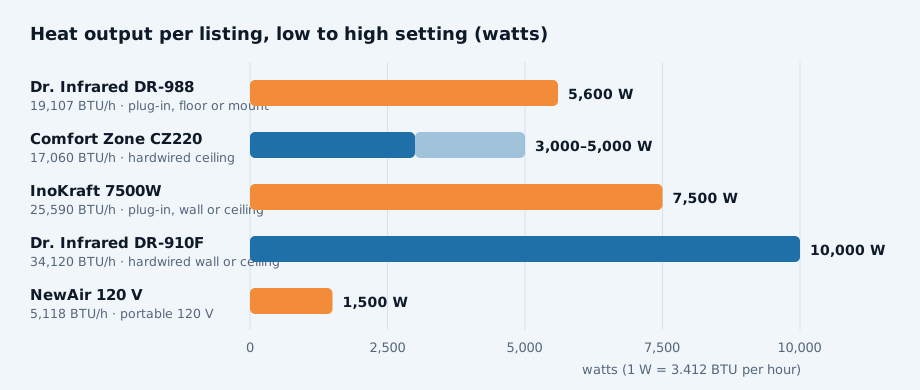
Bar chart of the heat output of the five electric garage heaters in watts, from 1,500 W for the 120 V NewAir to 10,000 W for the Dr. Infrared DR-910F
Heat output per listing. Every watt of an electric heater ends up as heat, so these numbers compare directly. Hardwired heaters in blue, plug-in and portable heaters in orange; the Comfort Zone shows its 3,000 W low setting.

What each heater draws, and the circuit behind it

  • Current on full heat
  • Up to the typical circuit or outlet rating
0 A816243240485664

Amps are our arithmetic, watts divided by volts. Circuit sizes are typical for a continuous load (at least 125 % of the heater’s current); a licensed electrician and your local code set the real ones.

  1. Measure the floorMultiply length by width, then allow about 10 W per square foot, more if the garage is drafty. Which size
  2. Check the supplyAn ordinary outlet, a NEMA 6-30, a NEMA 14-50 or a hardwired circuit each feed a different heater. 120 V or 240 V
  3. Call the electricianA new 240 V outlet or a hardwired heater is licensed work, with a permit where required. The circuit
  4. Mount it highOff the floor, angled at the work area and away from fuel and paint vapors. Mounting

Garage door leaking cold air? Our insulation guide shows how a door seal and some ceiling batts let a smaller heater do the job.

How to choose

How to pick the right electric heater for your garage

Six points decide it. Your floor area and your panel matter more than the biggest number on the box, and so does the way you use the garage.

Watts and garage size

Budget near 10 W per square foot in a sealed and insulated garage and 12 to 15 W in a leaky one. Makers’ area claims run optimistic. Size your heater.

Outlet or hardwired

A plug-in like the DR-988 needs the matching 240 V outlet. A hardwired heater needs an electrician to connect it. Never bridge the gap with an adapter. Wiring it.

Mounting

High on a wall or ceiling frees the floor and keeps the heater away from vapors that settle low. A portable goes where you work. Where to mount it.

Thermostat and controls

Holding 40 to 50 °F protects stored paint and glue for far less than 65 °F. A remote, like the InoKraft’s, saves a ladder climb. Thermostat settings.

Fan-forced or infrared

Fan-forced heaters warm the air in a closed garage fast. Radiant heat warms you and the bench and suits a drafty space. Which warms you.

Running cost

Multiply kilowatts by hours by your rate. A 5 kW heater flat out uses 5 kWh an hour, and the thermostat cuts that. What it costs.

The 5 heaters

Five electric garage heaters, side by side

Our top pick first, then the budget ceiling heater, the 50 A plug-in, the big hardwired unit and the 120 V option. Each card names the catch.

Dr. Infrared Heater DR-988 red metal garage and shop heater with a steel safety grille and a 240 volt plug Our top pick

Dr. Infrared DR-988

The one we would hang in our own garage.

  • TypeFan-forced, floor or wall and ceiling mount
  • Heat5,600 W (about 19,100 BTU per hour)
  • Supply240 V, NEMA 6-30 outlet, 30 A
  • ControlsBuilt-in thermostat, fan ON or AUTO
  • Warranty1 year limited, components
  • Ideal forInsulated one- and two-car garages

Good to know: It needs a dedicated 30 A outlet, the thermostat sits in the heater, and the shared Dr. Infrared review pool brings up fan noise. The outlet it needs.

Read the full DR-988 review

$$$100 to $250
Comfort Zone CZ220 black ceiling mount garage heater with louvers, two control knobs and a mounting bracket Budget ceiling pick

Comfort Zone CZ220

A clear floor for the least money.

  • TypeFan-forced ceiling mount, hardwired
  • HeatThree settings up to 5,000 W (17,065 BTU)
  • Supply240 V, 20.9 A, 30 A circuit typical
  • ControlsThermostat and heat-setting knobs, up to 95 °F
  • Warranty1 year
  • Ideal forTwo-car garages on a budget

Good to know: It has no plug, so an electrician wires it in. The 1,000 sq ft claim is generous, and some owners report units that failed early. Mounting it.

Read the full Comfort Zone CZ220 review

$under $100
InoKraft 7500 watt wall or ceiling garage heater with a digital display, remote control and a 50 amp plug Plugs into a 50 A outlet

InoKraft 7500W

More heat from the outlet you charge the car on.

  • TypeFan-forced, wall or ceiling, five angles
  • Heat7,500 W (about 25,600 BTU), high, low and ECO
  • Supply240 V, 31.25 A, NEMA 14-50 plug
  • ControlsDigital thermostat 40 to 99 °F, timer, remote
  • Noise65 dB (listing)
  • Ideal forLarger garages with a 14-50 outlet

Good to know: Fewer owner reports so far, since the listing is younger, and no warranty term on it. The listing asks for a professional electrician to install it. Using its thermostat.

Read the full InoKraft 7500W review

$$$100 to $250
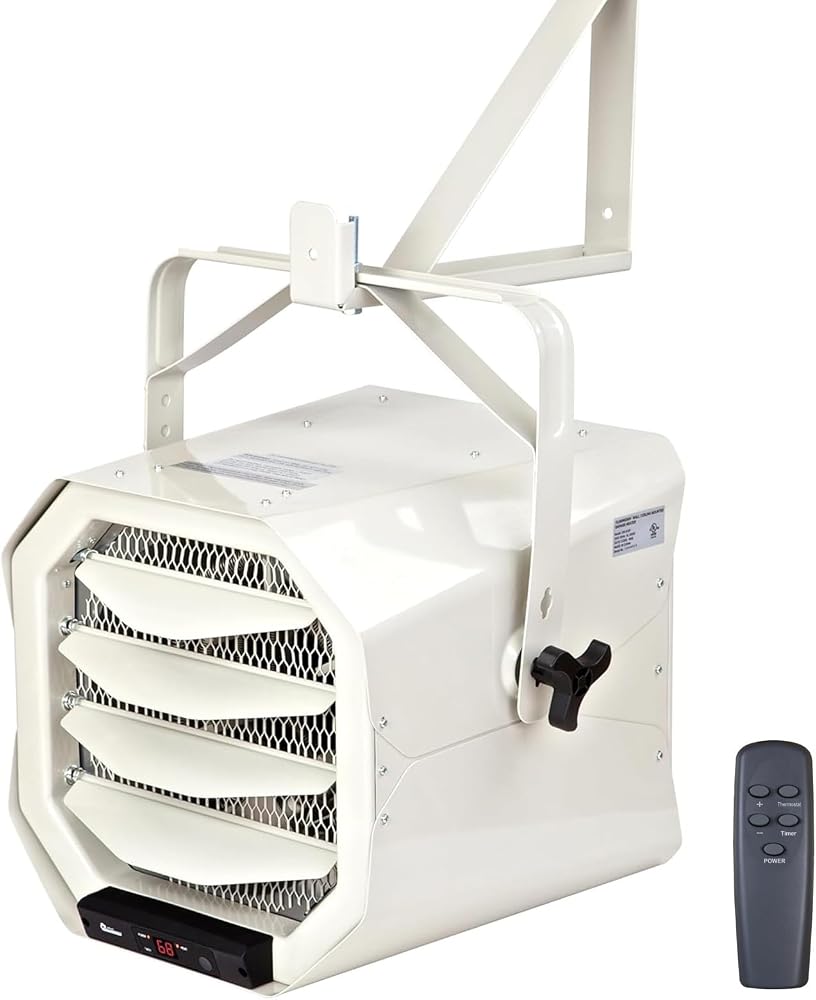
Dr. Infrared Heater DR-910F white 10,000 watt wall or ceiling shop heater with louvers and a remote control For big garages

Dr. Infrared DR-910F

Shop-size heat for a three-car garage.

  • TypeFan-forced wall or ceiling, hardwired
  • Heat10,000 W (about 34,100 BTU per hour)
  • Supply240 V, about 42 A, 6 AWG copper per listing
  • ControlsRemote thermostat 50 to 85 °F, timer
  • Warranty1 year limited, parts and labor
  • Ideal forBig shops, tall ceilings, drafty spaces

Good to know: It typically needs a 60 A circuit that not every panel can spare, weighs 49 lb, and owners report a loud fan and rattles. Do you need 10,000 W?

Read the full DR-910F review

$$$over $250
NewAir NGH160GA00 small black and gray portable garage heater with a tilting head and carry handle No 240 V needed

NewAir 120 V heater (NGH160GA00)

Warm hands at the bench, from any outlet.

  • TypePortable ceramic fan heater, tilting head
  • Heat1,500 W (about 5,100 BTU), two settings
  • Supply120 V, 12.5 A, ordinary household outlet
  • SafetyCool-touch exterior, auto shut-off, ETL
  • Weight4.4 lb, carry handle
  • Ideal forBenches, sheds and studios up to 160 sq ft

Good to know: Its output falls far short for a cold two-car garage, and a few owners describe cold air or units dying within months. Plug it into the wall, never a power strip. Is 120 V enough?

Read the full NewAir 120 V review

$under $100

Honest note: these are Amazon affiliate links. As an Amazon Associate we earn from qualifying purchases at no cost to you, and it changes nothing about the order or the catches we name.

Before you buy

Eight things about garage heaters no listing prints in big letters

None of these sits at the top of a product page, and all eight shape your first winter with an electric heater in the garage.

What you should know

  1. The outlet decides more than the heater. A 240 V plug-in needs its exact outlet, a 6-30 or a 14-50, and a hardwired heater needs a circuit of its own. The circuit
  2. Adapters and dryer outlets are off limits. Forcing a heater onto the wrong outlet skips the protection the breaker and wire give. A licensed electrician adds the right one
  3. A 120 V heater is a bench heater. At 1,500 W it warms you, not a cold two-car garage, and it needs a circuit with nothing else on it. 120 V or 240 V
  4. Area claims run high. Makers’ “heats up to” figures assume a sealed, insulated space. Use about 10 W per square foot and more for a drafty garage. Sizing
  5. The garage door loses the most heat. Weatherstripping with a bottom seal, plus an insulated door, cuts demand more than a bigger heater would add. Insulating
  6. Fuel vapors settle low. Gasoline and solvents give off vapors heavier than air. Mount the heater high and never run it while you spray or fuel. Safety rules
  7. Built-in thermostats read the heater’s own air. That is why they can cycle early or late. Set by feel at first, or wire a hardwired heater to a wall thermostat. Thermostat tips
  8. A tripping breaker is a warning, not a nuisance. It usually means a shared or undersized circuit. Never swap in a bigger breaker, because it protects the wire. Fixes to try

Everything in one table

Five electric garage heaters, catch included

Each row puts a heater’s strength right next to its catch.

Swipe the table sideways to see all columns →

Heater Ideal for Band Type Heat and area Supply and current Strength and catch View
Dr. Infrared DR-988 (our top pick) Insulated one- and two-car garages $$$100 to $250 Plug-in
floor or mounted
5,600 W (19,100 BTU); 600 sq ft (maker) 240 V, about 23.3 A, NEMA 6-30 outlet Right size, no hardwiring, floor or wall. Needs a 30 A outlet, fan noise.
Comfort Zone CZ220 Two-car garages on a budget $under $100 Hardwired
ceiling mount
3,000 to 5,000 W; 1,000 sq ft claimed, nearer 500 240 V, 20.9 A, 30 A circuit typical Cheap, three settings, clear floor. Electrician needed, early failures reported.
InoKraft 7500W Larger garages with a 50 A outlet $$$100 to $250 Plug-in
wall or ceiling
7,500 W (25,600 BTU); up to 750 sq ft (maker) 240 V, 31.25 A, NEMA 14-50 outlet Remote, timer, ECO mode, 65 dB. Young listing, no stated warranty.
Dr. Infrared DR-910F Big shops and three-car garages $$$over $250 Hardwired
wall or ceiling
10,000 W (34,100 BTU); about 1,000 sq ft by rule of thumb 240 V, about 42 A, 60 A circuit typical Most heat, remote thermostat. Big circuit, heavy, loud fan reported.
NewAir 120 V heater Benches, sheds and studios $under $100 Portable
120 V ceramic
1,500 W (5,100 BTU); up to 160 sq ft (maker) 120 V, 12.5 A, ordinary outlet No wiring, light, ETL listed. Bench heat only, not a garage heater.

Figures from the Amazon.com listings and, where marked, from the maker. BTU and amps are worked out by us from the watts. Only the price Amazon shows at checkout counts.

Ready for the first frost

Plug in the DR-988 and get back to work

For a one- or two-car garage, this is the heater we would buy. It has the right output, it needs only one outlet, and it stands on the floor or hangs on the wall.

Give it a dedicated 6-30 outlet, a spot away from fuel and paint, and a sensible thermostat setting. Then the bench stays warm enough to work at all winter.

$$

$100 to $250 · 240 V plug-in · Dr. Infrared

  • ✓ 5,600 W, about 19,100 BTU per hour
  • ✓ NEMA 6-30 plug, no hardwiring
  • ✓ Floor, wall or ceiling
  • ✓ UL and C-UL listed

Good to know

Why an electric heater acts the way it does, in a cold garage

A few minutes of background makes the habits of a garage heater much easier to live with.

An electric garage heater runs current through a coil or ceramic element and blows air across it. Nothing burns, so nothing needs a vent, and every watt it draws turns into heat.

01Why it needs 240 V

An ordinary 120 V outlet tops out near 1,500 W for a heater. Doubling the voltage lets a heater draw far more power on a reasonable current, which is how 5,000 W and up becomes possible. The difference.

02Why the circuit is sized above the heater

Space heating is treated as a continuous load, and the circuit gets rated for at least 125 % of what the heater draws. That is why a heater drawing about 23 A typically sits on a 30 A breaker.

03Why it blows cool air sometimes

When the thermostat is satisfied, the element switches off while the fan may keep running, especially in an ON fan mode. Steady cold air can mean a tripped overheat cut-off or a failed element.

A garage heater lives on three things: the right circuit, a sealed door and a thermostat set to what you need.

04Why the heater cannot fix a leaky door

Warm air rises and slips out through gaps, and an uninsulated steel door loses heat faster than any wall. Seal it first, and a smaller heater keeps up. Keeping heat in.

3.412BTU per hour in every watt

10 WPer square foot, insulated garage

125 %Circuit rating over heater current

40 to 50 °FEnough to protect paint and batteries

Want the full safety picture? Read the eight safety rules before the first cold morning.

Questions and answers

Frequently asked questions about electric garage heaters

Twelve questions that come up again and again, with full answers.

What is the best electric garage heater?

For most two-car garages, the Dr. Infrared DR-988, with 5,600 W from one NEMA 6-30 outlet, on the floor or mounted high. On a budget, the hardwired Comfort Zone CZ220; for a big shop, the DR-910F. All five sit in the comparison table.

What size heater does a two-car garage need?

The usual rule of thumb gives an insulated garage around 10 W per square foot. For a 24 × 24 ft garage that comes to about 5,000 to 6,000 W, and a drafty one needs more. Size it for your garage.

Can a 120 V heater warm a garage?

Only a small one, or the spot where you work. A 120 V heater tops out near 1,500 W, a quarter of what a cold two-car garage needs. When 120 V is enough.

Do I need an electrician for a 240 V garage heater?

For a new outlet or a hardwired heater, yes, it takes a licensed electrician, and a permit where your town asks for one. Where the right outlet already exists, a plug-in heater goes straight in. What the job involves.

What breaker does a 5,600 W heater need?

Drawing about 23.3 A, it usually gets a 30 A two-pole breaker and 10 AWG copper behind its NEMA 6-30 outlet, because heaters count as continuous loads. Your electrician confirms the sizes.

Can I plug a garage heater into my EV charger outlet?

If it is a NEMA 14-50 outlet, a heater with the matching plug, like the InoKraft 7500W, fits. You cannot charge the car and run the heater on it at once. Never use an adapter for any other heater.

How much does an electric garage heater cost to run?

Multiply kilowatts by hours by your rate. A 5 kW heater flat out uses 5 kWh an hour, 75 cents at 15 cents per kWh as an example. The thermostat cycles it, so real use is lower. Work out your own.

Is an electric heater safe in an attached garage?

It makes no carbon monoxide and needs no vent. The risks are fire and wiring, so keep it away from gasoline and paint, keep the clearances, and never cover it. The eight rules.

Should I mount the heater on the ceiling?

Mounting high frees the floor and keeps the heater away from cars and the fuel vapors that settle low. Aim it at the work area at an angle, not straight down. Where to mount it.

Why does my garage heater trip the breaker?

Usually the circuit is shared or too small for the heater, or there is a fault in the element or wiring. Never fit a bigger breaker on the same wire. Seven fixes.

Why don’t you show prices?

They change often, so a fixed price here would soon be wrong. We give a band instead ($ under $100, $$ $100 to $250, $$$ over $250), and the button takes you to the product page, where the price at checkout counts.

Did you test these heaters yourselves?

No, and we say so openly. We read the Amazon listings and the makers’ figures, then weighed them against owner reports. Where sources disagree or a figure comes from the maker, we show where each number comes from.

Reviews

A closer look at each heater

Each review sets the full specs next to what owners report, and names the rivals worth a look.

Head-to-head

Torn between two? Four matchups, settled

A 30 A plug against a 50 A plug, 7,500 W against 10,000 W, two hardwired heaters, and 120 V against 240 V.

Read before you buy

Guides to safe, steady heat in your garage

Ten background guides, three buying guides and a glossary. Each gives the long answer instead of the short one.