What an electric garage heater costs to run
An electric heater turns almost every watt it draws into heat, so its running cost comes down to simple arithmetic. Multiply kilowatts by hours by the price on your bill, then let insulation and the thermostat decide how many of those hours really count.
The formula, kW × hours × rate
Every electric heater bill starts from the same sum. Take the heater’s output in kilowatts, multiply it by the hours its element is on, then multiply by the price you pay per kilowatt-hour.
A 5,000 W heater is 5 kW. Running flat out for one hour it uses 5 kWh, and at 15 cents per kWh that hour costs 75 cents. Use the rate printed on your own bill, since prices vary a lot from state to state.
Nothing is lost up a flue. An electric heater has no exhaust and no fuel to burn, so the watts on the label are the heat you pay for. The only open question is how many hours the element stays on.
Cost per hour for the five heaters
The table shows each heater at full output for one hour, using 15 cents per kWh as a worked example. Treat it as the ceiling, the most an hour can cost, because a thermostat switches the element off once the garage is warm.
| Heater | Output | Energy per hour at full output | Cost per hour at 15 cents per kWh |
|---|---|---|---|
| NewAir NGH160GA00 | 1,500 W | 1.5 kWh | about 23 cents |
| Comfort Zone CZ220 | 3,000 / 4,000 / 5,000 W | 3 to 5 kWh | 45 to 75 cents |
| Dr. Infrared DR-988 | 5,600 W | 5.6 kWh | about 84 cents |
| InoKraft 7500W | 7,500 W | 7.5 kWh | about 113 cents |
| Dr. Infrared DR-910F | 10,000 W | 10 kWh | 150 cents |
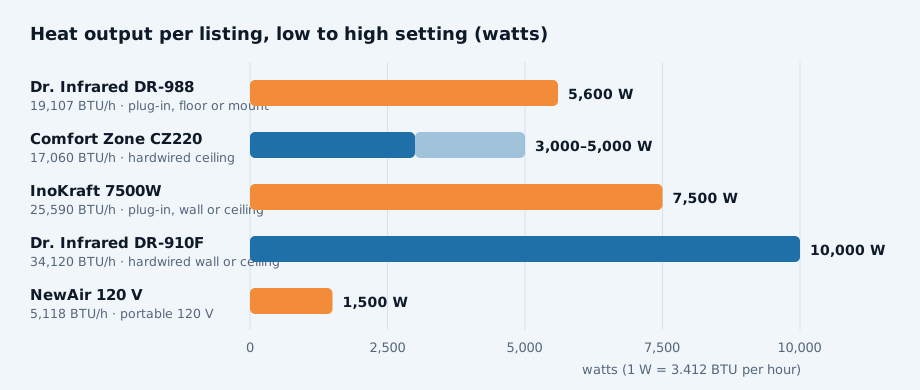
The Dr. Infrared DR-910F looks expensive per hour, yet it is built for a big garage that loses heat fast. In a small, tight garage it would reach temperature quickly and then sit idle most of the time.
Why a heater rarely runs flat out
The thermostat clicks the element on when the air drops below your setting and off when it climbs back. How long it stays on depends on how fast the garage leaks heat, which comes down to insulation and the weather outside.
On a mild afternoon a well-sealed garage might need the element for a few minutes in each hour. On a bitter night with an uninsulated steel door, the same heater can run almost without a break and still fall behind.
That is why nobody can give you a fixed cost per month. The heater sets the most you can spend per hour, while your insulation and the big door decide how close you get to it.
A Saturday in the garage, worked through
Say you run a Dr. Infrared DR-988 for six hours of weekend projects. If the thermostat keeps the element on about half the time (an assumption for the example, not a measurement), you use 5.6 × 6 × 0.5, or 16.8 kWh.
At 15 cents per kWh that day costs about 252 cents, a little over two and a half dollars. Double the on-time for a drafty garage on a frigid day and the figure doubles too. Halve it in a snug garage and it halves.
- Heater output
- 5.6 kW
- Hours in use
- 6
- Share of time the element is on
- about 50 % (example)
- Energy used
- 16.8 kWh
- Cost at 15 cents per kWh
- about 252 cents
Does a bigger heater cost more to run?
Not by itself. The heat your garage loses per hour is the same whatever heater replaces it, so a 10,000 W unit simply runs for shorter bursts than a 5,000 W one holding the same temperature.
The bigger heater does cost more when you ask more of it. It warms a cold garage faster, which tempts you to heat it more often, and it pulls a far larger current, so the wiring costs more up front.
An undersized heater is the worse deal. It runs nonstop, never reaches your setting and leaves you cold for the same money. Match the output to the floor area with the guide to sizing a garage heater before you worry about the hourly rate.
Does 120 V heat cost less than 240 V?
No. A watt costs the same at any voltage, so 1,500 W at 120 V and 1,500 W at 240 V use identical energy. The difference is how much heat each circuit can carry, not the price per unit of heat.
A small 120 V heater feels cheap because it delivers so little. The guide to 120 V or 240 V garage heaters explains why 1,500 W warms a bench, not a two-car garage, and the cheap garage heater guide shows what a low price gives up.
What pushes the bill up
- An uninsulated garage door and gaps under it, the biggest heat leak in most garages
- No ceiling insulation, so warm air escapes upward
- Holding 65 °F all day when you only work there a few hours
- Opening the big door often, which dumps the warm air a fan heater has built up
- A heater left on overnight in an empty garage
What brings it down
Seal the door first. Weatherstripping and a bottom seal cost little and cut demand quickly. The guide to insulating a garage for heat puts the jobs in order, from the door to the ceiling and walls.
Then turn the setting down. Holding about 40 to 50 °F protects paint, glue, batteries and pipes for far less than 65 °F, and you raise it only when you are working. The thermostat settings guide covers the numbers for each heater.
Saving power never means cutting corners on safety. Run a 240 V heater only on its own dedicated circuit, fitted by a licensed electrician, and pull the plug on a portable unit before you walk out of the garage.
Picking a heater with the bill in mind
Our garage heater comparison lines up all five by output and supply, and the comparison table puts the current draw next to the rated area. A heater sized right for an insulated garage is the cheapest one to own over a winter.
For a typical insulated two-car garage the DR-988 card explains why 5,600 W fits, and it plugs into one NEMA 6-30 outlet rather than needing hardwiring.
If you heat a two-car garage on weekends
At 5,600 W, the Dr. Infrared DR-988 has enough output for a typical insulated two-car garage without a long wait, and its thermostat lets you hold a low frost-guard setting between projects. It needs a 240 V, 30 A outlet, so plan on an electrician’s visit if the garage has no such outlet yet.