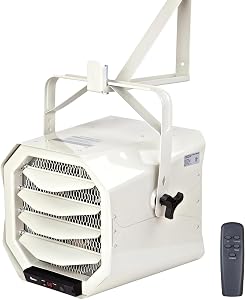
Comfort Zone CZ220, a budget ceiling heater
The CZ220 is the cheapest way on our list to get a proper 240 V heater off the garage floor. It hangs from the ceiling, offers three heat settings and costs less than the plug-in Dr. Infrared. We did not test one, so this review reads the listing and owner reports, including where the maker’s numbers run ahead of the arithmetic.
 Budget ceiling pick
Our verdict
The CZ220 is a sensible buy if you want a fixed 240 V heater on the ceiling and an electrician is coming anyway. It gives three heat settings, a steel body and louvers you can aim, all in the $ band. Its 1,000 sq ft rating is generous for 5,000 W, which suits nearer 500 sq ft of insulated garage, and some owners report units that failed early. Treat it as a good-value heater for an insulated two-car garage, not a big shop.
Strengths
- $ band price for a 5,000 W, 240 V heater
- Mounts on the ceiling and frees the floor
- Three heat settings, 3,000, 4,000 or 5,000 W
- Adjustable angle and louvers to aim the air
- Heavy-gauge steel body and an overheat shut-off
Weaknesses
- Must be hardwired, no cord or plug in the box
- 1,000 sq ft rating is generous for 5,000 W
- Some owners report units that failed early
- Noise and temperature control get mixed reports
- Thermostat tops out at 95 °F and sits in the heater
Buy it if
you want a fixed ceiling heater for an insulated one- or two-car garage on a modest budget, and a licensed electrician will wire it in.
Skip it if
you need a heater you can unplug and move, you heat a large or drafty shop, or you want a long and unblemished owner track record.
Specs: Comfort Zone CZ220
| Type | Fan-forced ceiling-mount heater, hardwired (no cord or plug) |
|---|---|
| Heat output | 3,000, 4,000 or 5,000 W; 17,065 BTU on high |
| Power | 240 V, 20.9 A |
| Controls | Thermostat knob and heat-setting knob, up to 95 °F; power light |
| Air direction | Adjustable mounting angle and louvers |
| Rated area | 1,000 sq ft (maker claim; nearer 500 sq ft by our rule of thumb) |
| Build | Heavy-gauge steel body |
| Safety | Overheat sensor with automatic shut-off |
| In the box | Heater, mounting bracket, manual |
| Size and weight | 14.02 × 12.91 × 10.63 in, 20.4 lb |
| Warranty | 1 year |
Data from the Amazon.com listing and, where marked, from the maker. Price band $: under $100. Only the price Amazon shows at checkout counts.
Three settings and a generous rating
The CZ220 switches between 3,000, 4,000 and 5,000 W, and the listing puts the top setting at 17,065 BTU. Having three steps lets you run it gently on a mild day and save the full output for a hard frost.
The spec table claims heating coverage of 1,000 sq ft. That is a maker figure and a generous one. Sizing at roughly 10 W per insulated square foot, 5,000 W matches nearer 500 sq ft, roughly a two-car garage.
In an uninsulated garage the useful area shrinks again, to something like 330 to 420 sq ft at 12 to 15 W per square foot. Our garage insulation guide shows how a door seal and ceiling insulation stretch those numbers.
Hardwiring it to a 240 V circuit
There is no cord or plug in the box, only the heater, a mounting bracket and the manual. The CZ220 has to be wired permanently to a 240 V circuit, work that belongs to a licensed electrician, plus a permit if your town asks for one.
The listing gives 20.9 A at 240 V, and our arithmetic says 20.8 A, so the two agree. Because heating is a continuous load the circuit wants at least 125 % of that, which usually means a two-pole 30 A breaker and 10 AWG copper. Your electrician has the final word.
Hardwiring adds a cost the shelf price does not show, so get the electrician’s quote before you compare it with a plug-in. If a 240 V circuit already runs near the ceiling, the job is smaller. Our guide to 240 V garage wiring explains what the electrician will check.
Up on the ceiling
A ceiling heater stays out of the way of cars and bikes, and it keeps the hot element far above the fuel and solvent vapors that tend to collect near the floor. That alone makes it a good fit for a garage that still parks a car.
The bracket allows an adjustable mounting angle and the louvers aim the air. Point it at an angle toward where you stand or work rather than straight down, and mind the clearance the manual asks for around the unit. The steel body weighs 20.4 lb, so the bracket needs solid framing.
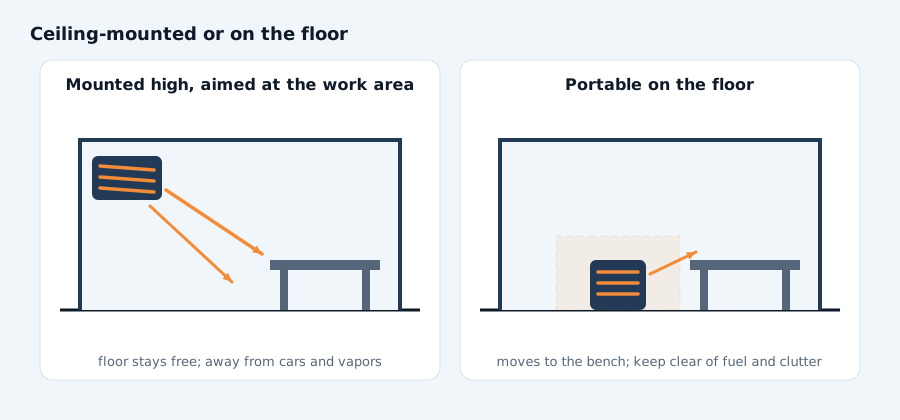
Height and angle get more detail in our guide to mounting a garage heater, including why a corner aimed across the room often beats the middle of the ceiling.
Two knobs, no remote
Control is old-school, with a thermostat knob and a heat-setting knob, and a power light shows when it is live. There is no remote, display or timer, so you set it with a ladder or a long stick and leave it.
The thermostat reaches up to 95 °F per the spec table and sits inside the heater, where it reads air the heater has just warmed. Owners give mixed reports on how steadily it holds a temperature, so a cheap thermometer at bench height tells you what the knob cannot.
Because the knobs live on the heater, set them once the unit is up and then leave them alone. A ceiling heater is easy to forget, so check the thermostat before a cold snap arrives rather than in the middle of one.
Noise, build and safety
The body is heavy-gauge steel, and an overheat sensor shuts the heater off automatically if it runs too hot. Electric heat makes no fumes or carbon monoxide, so the safety work comes down to clearances and a proper circuit, with flammable liquids kept well away.
Noise gets mixed reports from owners. Some find the fan unobtrusive, others hear it clearly, and a ceiling unit at least puts that noise above your head rather than beside your ear at the bench.
Measuring 14.02 × 12.91 × 10.63 in, it is compact for a 5,000 W heater. The warranty is 1 year against manufacturer defects. Keep the area below it free of tall shelving or stacked boxes that would block the airflow.
Running cost on each setting
Cost follows kilowatts times hours times your electricity rate. On high the CZ220 uses 5 kWh an hour, about 75 cents at 15 cents per kWh, and the 3,000 W setting uses about 45 cents an hour at the same example rate.
The thermostat cycles the element, so the real figure depends on insulation and the weather. Check your own bill for the rate, since it varies widely from one utility to the next.
What CZ220 owners praise and where units failed
The praise centers on heat and value. Owners say it warms garages and workshops well, and one reports reaching 70 °F after about two and a half hours. Easy installation and good value come up often too.
The complaints matter more on a heater you wire in. Some units failed early, a few within the first two weeks, and temperature regulation gets mixed reports. Test it right after installation, while the return window is still open.
None of these themes rules the heater out. The early failures are why we would rather see it warming an insulated garage on a sensible setting than running flat out all day in a drafty one.
How it stacks up against the rivals
The Dr. Infrared DR-988 costs more and gives 5,600 W, but it runs from a NEMA 6-30 plug and works as a floor unit or a mounted one. It also has a longer Amazon track record.
For a big shop the Dr. Infrared DR-910F doubles the output on a heavier circuit, and our Comfort Zone or DR-910F comparison sets the two hardwired heaters side by side. Without 240 V at all, the NewAir 120 V heater covers a bench and little more.
The CZ220 has its budget ceiling card on the homepage, alongside the rest of our electric garage heater comparison.
For a fixed heater on a tight budget
If an electrician is wiring your garage anyway and you want the heater off the floor for little money, the CZ220 does that job well in an insulated two-car garage. Size it by the arithmetic, not the 1,000 sq ft claim, and test it as soon as it is wired.