Wiring a 240 V garage heater
A real garage heater needs a 240 V circuit of its own, and that circuit is a job for a licensed electrician. This guide explains the breaker and wire sizes they are likely to propose, and the outlet that goes on the end, so you can choose a heater your panel can feed and plan the work before you buy.
Adding a 240 V circuit means working inside your main panel. That belongs in the hands of a licensed electrician, and many towns ask for a permit too. This guide explains what they will discuss with you; it is not a set of wiring instructions.
Why big garage heaters run on 240 V
Current is watts divided by volts. At 240 V, a 5,600 W heater draws about 23.3 A; at 120 V the same heat would need about 47 A, far more than any household outlet circuit carries.
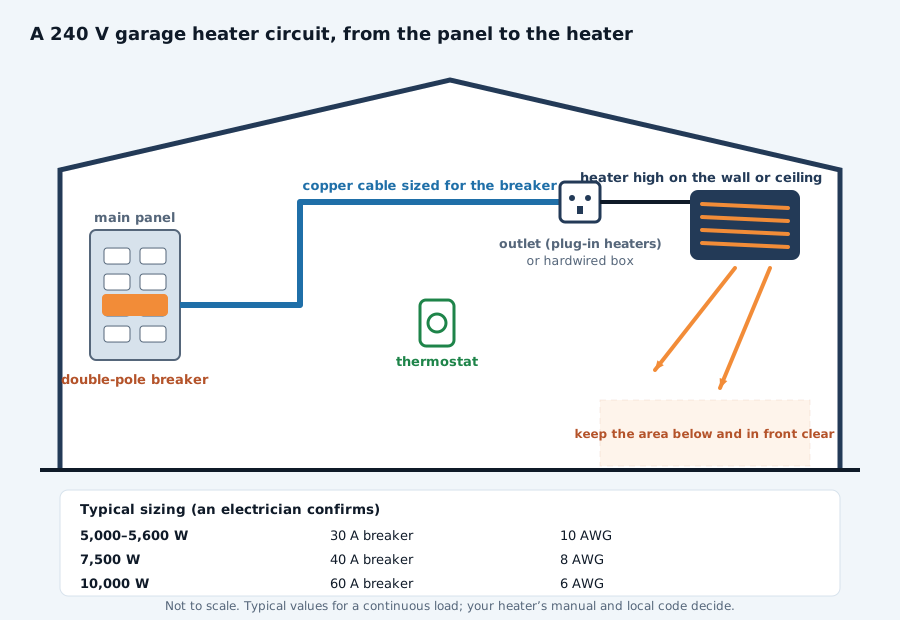
That is why every heater above 1,500 W in our lineup is a 240 V model. A 240 V circuit uses two hot conductors fed by a double-pole breaker, which takes two slots in the panel.
The continuous-load rule
Under the electrical code, a heater counts as a continuous load. The circuit has to carry at least 125 % of its draw, so 23.3 A becomes roughly 29 A, and the next standard size up is a 30 A breaker.
The breaker protects the wire, not the heater. Breaker and wire sizes therefore travel together, and a bigger breaker on the same cable is never the answer to a heater that trips.
Typical breaker and wire sizes
The diagram traces the circuit from the panel to a heater mounted high on the wall. The table applies the 125 % rule to the four 240 V heaters we compare.
| Heater | Current draw | × 125 % | Typical breaker | Typical copper wire | Connection |
|---|---|---|---|---|---|
| Comfort Zone CZ220, 5,000 W | 20.9 A (listing) | about 26 A | 30 A | 10 AWG | Hardwired |
| Dr. Infrared DR-988, 5,600 W | 23.3 A | about 29 A | 30 A | 10 AWG | NEMA 6-30 outlet |
| InoKraft 7500W, 7,500 W | 31.25 A | about 39 A | 40 A | 8 AWG | NEMA 14-50 outlet |
| Dr. Infrared DR-910F, 10,000 W | 41.7 A | about 52 A | 60 A | 6 AWG (listing) | Hardwired |
These are typical values for copper cable. The heater’s manual, the length of the run and your local code decide the final sizes, and an electrician will confirm them for your panel.
Plug-in heaters
The Dr. Infrared DR-988 ships with a NEMA 6-30P plug on a 6 ft cord. It wants an outlet of its own, a NEMA 6-30R good for 250 V at 30 A, and where one already exists no further wiring is needed.
The InoKraft 7500W ends in a NEMA 14-50P on an 8.2 ft cord. That four-prong 50 A plug matches the outlet many EV chargers and RV hookups use. Its listing still says installation must be done by a professional electrician, who will check the outlet’s circuit against the heater.
- NEMA 6-30
- 250 V, 30 A; two flat blades and a ground
- NEMA 14-50
- 125/250 V, 50 A; four prongs
- NEMA 5-15
- The ordinary 120 V household socket
Hardwired heaters
The Comfort Zone CZ220 and the DR-910F have no cord at all. The electrician runs the circuit to the mounting spot and connects the heater directly, as our Comfort Zone CZ220 review describes for that model.
Hardwiring keeps cords off the floor and suits a heater that will never move. Many hardwired heaters can also work with a separate wall thermostat, which regulates better than one inside the heater, so check the manual before the cable goes in.
What never to do
- Use an adapter to put a heater on an outlet it was not made for, such as a dryer outlet
- Run a 240 V or 1,500 W heater from an extension cord or power strip
- Swap in a bigger breaker because the heater keeps tripping the old one
- Share the heater’s circuit with a compressor, welder or other heavy load
- Open the panel yourself to add a circuit
Each of these can overheat a wire inside a wall long before anything trips. Our garage heater safety rules cover the rest of the precautions worth taking once the heater is in.
Planning the job with your electrician
- Heater size: settle the watts first with our sizing guide, since they set the breaker
- Mounting spot: decide where the heater goes, so the outlet or junction box lands within reach
- Panel capacity: two free slots and enough spare service for the new load
- Distance: a detached garage or a long run may need heavier cable or a subpanel
- Permit: many towns require one for a new circuit, and an inspector checks the work
- Thermostat: for a hardwired heater, where a wall thermostat would sit, away from the airflow
Our guide on where to mount a garage heater helps you pick that spot before the electrician visits, so the outlet goes in the right place the first time.
Detached garages and subpanels
A detached garage is often fed by a single cable from the house, sometimes to a small subpanel. That feed may already run the lights and outlets as well as a door opener, so a 5,000 W or larger heater can push it past its rating.
Your electrician will add up the loads on that feed before suggesting a heater circuit. If the feed is too small, the choice is a heavier feed, a smaller heater, or better insulation so a smaller heater copes.
If the breaker trips later
A heater that trips its breaker is usually on a shared or undersized circuit, or it has a fault in an element or the wiring. Our guide to heater trips and cold air lists the likely causes and which ones need an electrician.
For the full lineup with current draw and supply side by side, see our electric garage heaters compared page. Its sizing and supply section pairs with the comparison table.
One outlet, no hardwiring
The Dr. Infrared DR-988 needs one 30 A NEMA 6-30 outlet, the simplest 240 V circuit of the heaters we compare. If your electrician is running a new circuit anyway, the hardwired Comfort Zone CZ220 on the same 30 A breaker is the cheaper choice.