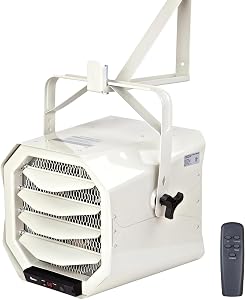
InoKraft 7500W, a heater for the 50 A outlet
The InoKraft 7500W is built around a plug many garages already have, the NEMA 14-50 used by EV chargers and RV hookups. It brings 7,500 W and a digital thermostat with an ECO mode, all set from a remote. We did not test one, and the listing is young, so this review leans on the listing and a smaller pool of owner reports.
 Plugs into a 50 A outlet
Our verdict
The InoKraft makes sense if your garage already has a NEMA 14-50 outlet and needs more heat than a 5,600 W unit gives. It brings 7,500 W and a digital thermostat with ECO mode, plus a remote and a timer, and owners call it well built and quiet. The listing is younger than the Dr. Infrared and Comfort Zone ones, owner reports are fewer, and no warranty is stated. The listing also asks for a professional electrician to install it, plug or not.
Strengths
- 7,500 W for a larger or colder garage
- NEMA 14-50 plug fits a common EV and RV outlet
- Digital thermostat with ECO mode, plus a 1 to 24 hour timer
- Remote control, which owners like
- Owners call it well built and quiet
Weaknesses
- Younger listing with fewer owner reports
- No warranty stated on the listing
- Wall or ceiling only, not a floor heater
- Draws 31.25 A, more than many garage circuits carry
- Listing still asks for a professional electrician
Buy it if
you have, or will add, a NEMA 14-50 outlet in a garage of around 600 to 750 sq ft and want a digital thermostat with a remote and a timer.
Skip it if
you want a long owner track record and a stated warranty, or you need a heater you can stand on the floor and move around.
Specs: InoKraft 7500W
| Type | Fan-forced wall or ceiling heater with a cord and plug |
|---|---|
| Heat output | 7,500 W (about 25,600 BTU per hour); high, low and ECO modes |
| Power | 240 V, 31.25 A |
| Plug | 8.2 ft cord with a NEMA 14-50P plug (8 AWG); the listing asks for a professional electrician to install |
| Controls | Digital thermostat 40 to 99 °F, 1 to 24 h timer, remote control |
| Noise | 65 dB (listing) |
| Rated area | Up to 750 sq ft (maker) |
| Mounting | Wall or ceiling, five angles, adjustable louvers |
| Safety | Overheat protection, automatic shut-off, fan delay |
| Size and weight | 17.71 × 15.74 × 15.15 in, 24.9 lb |
| Warranty | Not stated on the listing |
Data from the Amazon.com listing and, where marked, from the maker. Price band $$: $100 to $250. Only the price Amazon shows at checkout counts.
7,500 W and the 750 sq ft claim
InoKraft rates the heater at 7,500 W, about 25,600 BTU per hour by our arithmetic, and claims it heats up to 750 sq ft. That claim agrees with the familiar sizing figure of 10 W per insulated square foot.
For an uninsulated or drafty space, the rule climbs to 12 to 15 W per square foot, which brings the useful area down to roughly 500 to 625 sq ft. That is still close to a full 576 sq ft two-car garage.
High and low settings plus an automatic ECO mode let you scale the output. ECO adjusts the heat to the room temperature and can switch it off when it is not needed, which helps a heater this big avoid overshooting in a small space.
The NEMA 14-50 plug and your circuit
The heater comes with an 8.2 ft cord and a 14-50P, the four-pronged 50 A plug that EV chargers and RV hookups often use, and electric ranges too. The listing highlights 8 AWG wire in that cord.
At 240 V it pulls 31.25 A (7,500 ÷ 240). Heating is a continuous load, so the circuit has to carry at least 125 % of that. For a heater this size a 40 A breaker on 8 AWG copper is typical, and an electrician will tell you whether your existing 14-50 circuit suits it.
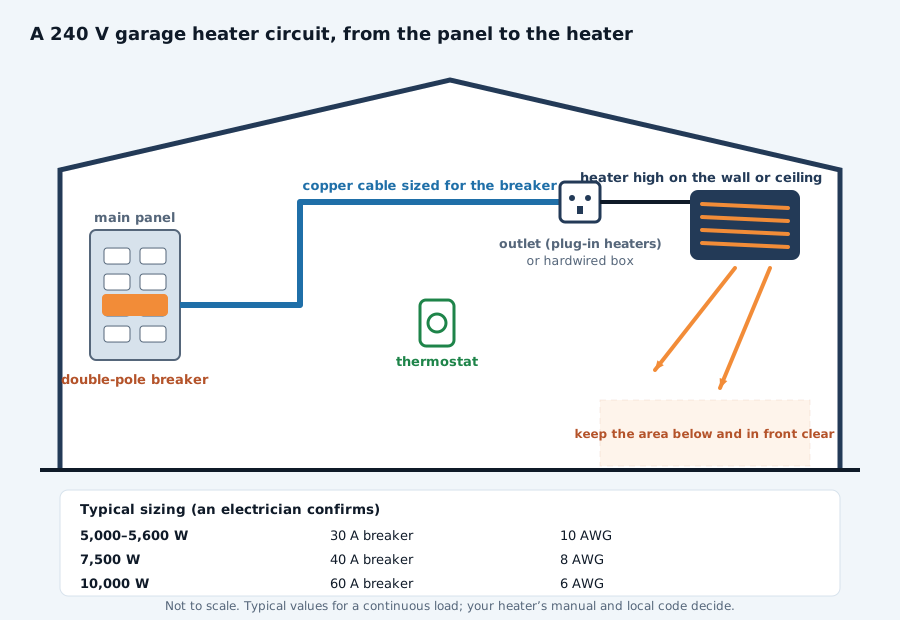
The listing itself says installation must be done by a professional electrician, even with the plug. That covers checking the outlet and circuit as well as mounting a 24.9 lb heater securely. Our guide to 240 V garage circuits explains what they will look at.
If your 14-50 outlet feeds an EV charger, plan for how the two will share it. Swapping plugs every day wears the outlet, so a second dedicated outlet is often the tidier fix. Never use a splitter or an adapter.
Wall or ceiling, five angles
This is a mounted heater, not a floor unit. It goes on a wall or ceiling with five mounting angles and adjustable louvers, which lets you aim the air at the bench or the car bay instead of at the rafters.
Up high it is clear of cars and of the fuel and solvent vapors that pool near the floor. Keep the clearances in the manual, and fix the bracket into framing, since the heater itself measures 17.71 × 15.74 × 15.15 in. Our guide on mounting a garage heater high covers height and angle.
Because it cannot stand on the floor, you cannot carry it to the bench on a bitter morning. Choose the mounting spot with care, since moving it later means another climb and a fresh set of holes.
Thermostat, timer and remote
The controls are the most modern in our lineup. A digital thermostat runs from 40 to 99 °F, a timer covers 1 to 24 hours, and a remote control lets you change the setting without a ladder.
The 40 °F floor matters. It lets you hold the garage at a frost-safe level for paint and batteries without paying to keep it warm, then turn it up with the remote when you walk in. Our guide to setting a garage heater thermostat covers which temperatures save the most.
Like every built-in thermostat, it reads air close to the heater, so it can switch off before the far corner warms. The ECO mode helps a little, and aiming the louvers away from the unit helps more.
Noise, build and safety features
The listing gives 65 dB, the only noise figure any of our five listings gives. Owners describe it as quiet for its output and well built, which stands out against the fan complaints on some rivals.
Safety features include overheat protection, an automatic shut-off and a fan delay that keeps the fan running briefly after the heat stops to clear the hot element. It makes no carbon monoxide, but it still needs its clearances and should never be covered.
Running cost at 7,500 W
An hour at full power uses 7.5 kWh. At 15 cents per kWh that comes to a little over a dollar, about 113 cents, and the thermostat and ECO mode cut that in daily use. Our guide to what a garage heater costs to run shows the method with your own rate.
A bigger heater does not cost more per unit of heat. It finishes warming the space sooner and then cycles. Insulation and the weather outside drive the bill far more than the rating does.
If you use the garage mostly at weekends, the timer is the bigger saving. Set it to start an hour before you arrive and to stop when you plan to leave, so the heater never warms an empty room.
Early signs from InoKraft owners
This is a younger listing with fewer owner reports than the Dr. Infrared and Comfort Zone heaters, so treat the themes as early signs. Owners call it well built and quiet, and they like the remote.
Several say it heats spaces up to about 750 sq ft, and one describes a 700 sq ft garage held around 60 °F. Owners also mention a simple install with clear instructions and good value. No warranty is stated on the listing, so check the return terms before mounting it.
Against the Dr. Infrared heaters
The Dr. Infrared DR-988 gives 5,600 W from a NEMA 6-30 outlet, works on the floor too and has a much longer track record. Our DR-988 or InoKraft comparison lays out the 30 A against 50 A choice.
For a big shop, the Dr. Infrared DR-910F brings 10,000 W, but it is hardwired and heavier. The cheaper Comfort Zone CZ220 suits an insulated two-car garage on a budget.
See the InoKraft’s card on the homepage, or our full list of the top electric garage heaters to set all five side by side.
When a 50 A outlet is already there
If your garage has a NEMA 14-50 outlet and a 5,600 W heater would be stretched, the InoKraft gives you more heat with the nicest controls in our lineup. Have an electrician confirm the circuit and mount it, and keep the paperwork, since owner history is still short.