Dr. Infrared DR-910F, a 10,000 W heater for big garages
The DR-910F is the heater on our list for a three-car garage, a large workshop or a cold space where 5,000 W falls short. It doubles the output of the 5,000 W Comfort Zone ceiling heater and adds a remote thermostat. We have not run one ourselves, so this review sets the listing beside owner reports and the circuit it demands.
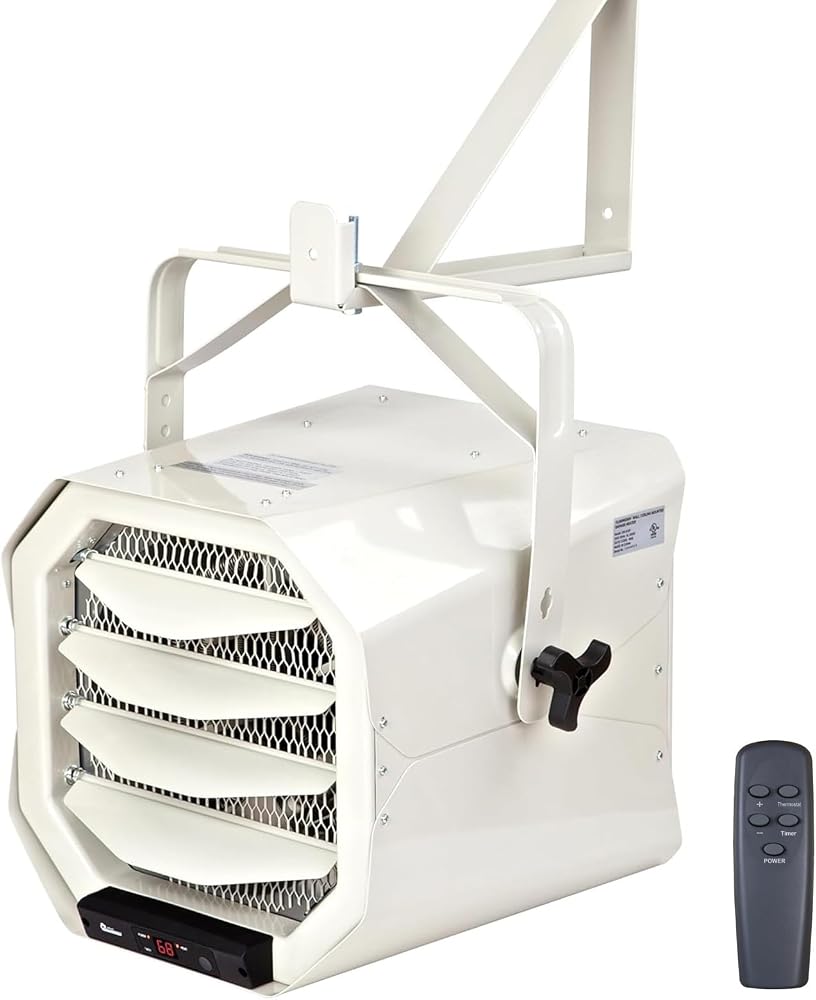 For big garages
Our verdict
The DR-910F is the heater to buy when your garage or shop is simply too big or too cold for 5,000 to 7,500 W. It brings 10,000 W and a remote thermostat with a timer. UL and cUL listings and a 1-year warranty on parts and labor back it up. It needs a hardwired circuit around 60 A with 6 AWG copper, which is a serious electrician job, and it costs the most of our five. Owners report fan noise and rattles, a thermostat that is not always accurate and air that can feel cool at times.
Strengths
- 10,000 W for large or poorly insulated spaces
- Remote-controlled thermostat with a timer
- Five adjustable louvers to spread the air
- Heavy-duty, fully enclosed motor
- UL and cUL listed, with a 1-year warranty on parts and labor
Weaknesses
- Needs a hardwired circuit of about 60 A
- The most expensive heater of our five
- Fan noise and rattles in owner reports
- Thermostat starts at 50 °F, so no 40 °F frost guard
- 49 lb, so the mounting needs solid framing
Buy it if
you heat a three-car garage, a big shop or a cold and drafty space, and your panel has room for a heavy 240 V circuit installed by an electrician.
Skip it if
your garage is an insulated one- or two-car space, your panel is already near its limit, or you want to keep the garage at a low background temperature.
Specs: Dr. Infrared DR-910F
| Type | Fan-forced wall or ceiling heater, hardwired (no cord) |
|---|---|
| Heat output | 10,000 W (about 34,100 BTU per hour) |
| Power | 240 V single phase, about 42 A; the listing calls for 6 AWG copper wire |
| Controls | Remote-controlled thermostat 50 to 85 °F, timer |
| Air direction | Five adjustable louvers |
| Motor | Heavy-duty, fully enclosed; one fan speed |
| Safety | UL and cUL listed |
| In the box | Heater, bracket, remote, manual |
| Size and weight | 22 × 18 × 16 in, 49 lb |
| Warranty | 1 year limited, parts and labor |
Data from the Amazon.com listing and, where marked, from the maker. Price band $$$: over $250. Only the price Amazon shows at checkout counts.
When a garage needs 10,000 W
Dr. Infrared rates the DR-910F at 10,000 W on 240 V single phase, about 34,100 BTU per hour by our arithmetic. That is twice the output of the CZ220 on high and nearly twice that of the DR-988.
Allow roughly 10 W of heat per square foot of insulated garage and 10,000 W stretches to about 1,000 sq ft. In an uninsulated or drafty building that needs 12 to 15 W per square foot, it suits something nearer 670 to 830 sq ft.
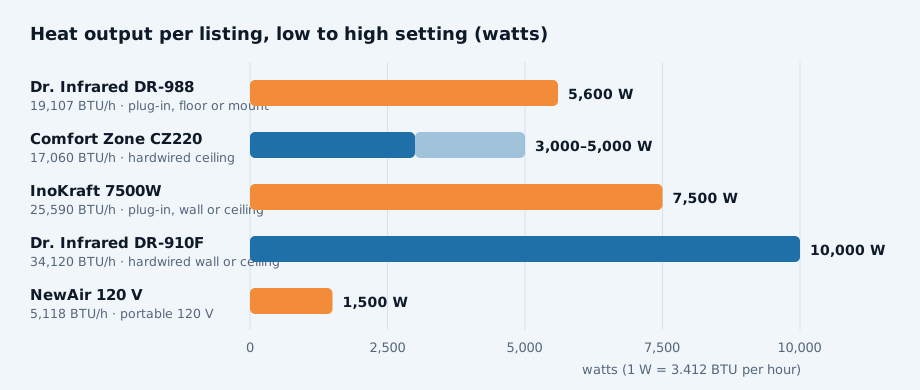
So it fits a three-car garage, a big workshop or a pole barn bay where a smaller heater would run flat out and never catch up. Our guide on what size heater a garage needs helps you check whether you are in that range or would be better served by a smaller unit.
Oversizing has a cost too. In a small, well-insulated garage a 10,000 W heater overshoots and cycles on and off, which is louder and less even than a smaller heater running steadily.
A heavy hardwired circuit
There is no power cord. The DR-910F is hardwired, and the listing calls for 6 AWG copper wire. The spec table gives 42 A, and 10,000 divided by 240 comes to 41.7 A, so the figures agree.
Because a heater runs as a continuous load, the circuit needs at least 125 % of that current. The typical result is a 60 A double-pole breaker on 6 AWG copper, a big slice of many home panels, and your electrician will confirm what yours can spare.
This is not a weekend job. A licensed electrician should run the circuit and wire the heater in, with a permit where your area requires one. Our guide to 240 V garage heater wiring covers the questions to ask before you get a quote.
Mounting a 49 lb heater
The heater mounts on a wall or ceiling with the included bracket. At 22 × 18 × 16 in and 49 lb, it needs solid framing behind it, not drywall anchors or a thin ceiling board.
Lifting that weight overhead from a ladder is a two-person job. Plan for a helper, or ask the electrician to hang the heater on the same visit as the wiring.
Five adjustable louvers spread the air. Mount it high in a corner and aim it across the space toward where you work, at an angle rather than straight down, and keep the clearances the manual sets out.
Height also keeps the hot element well above the gasoline and solvent vapors that settle near the floor. In a big shop with a parts washer or a paint corner, place the heater well away from that end.
Remote thermostat and timer
A remote-controlled thermostat covers 50 to 85 °F, and a timer lets you have the shop warm when you arrive. The remote saves a climb to a ceiling unit every time you want a change.
The 50 °F floor is a real limit. You cannot use this heater to hold a garage at 40 °F just to protect paint and pipes, so in a mostly empty shop you will switch it off and on rather than leaving a low setting.
Owners report that the thermostat is not always accurate. It reads air near the unit, so a thermometer at bench height tells you more, and the louvers aimed away from the heater can keep it from switching off early.
Noise, motor and safety
The motor is heavy-duty and fully enclosed, and the fan has one speed. That keeps the design simple, but it also means you cannot turn the fan down when the shop is warm and you want quiet.
Owners say the fan can be noisy and rattle. Some also mention air that feels cool at times, which can happen when the fan runs while the element cycles. Our guide to fixing a garage heater that trips or blows cold walks through what to check if it persists.
The DR-910F is UL and cUL listed. As an electric heater it makes no carbon monoxide, but it still needs clearance, a dedicated circuit and a garage kept clear of open fuel containers near it.
Running cost at full power
At full output the DR-910F uses 10 kWh every hour. At 15 cents per kWh that is a dollar and a half an hour, so read your own bill for the rate before you budget a winter.
Insulation decides the rest. A big heater in a leaky building runs much of the day, and sealing the door and insulating the ceiling cut its run time more than any thermostat trick. Our guide to keeping the heat in a garage shows where to start.
The timer helps as well. Set it to start shortly before you arrive rather than leaving a 10,000 W heater running through empty hours, and switch it off when the last job is done.
Owner reports on the shared DR-910F listing
Owner reviews for the Dr. Infrared shop heaters sit in a single Amazon pool, so reports on this listing mix several models. Read the themes as being about the family rather than only the DR-910F.
With that said, owners report that it puts out a lot of heat and warms a garage fast. The fan can be noisy and rattle, the thermostat is not always accurate, and the airflow can feel cool at times. The limited warranty runs 1 year and covers parts and labor.
Against the other big heaters
The InoKraft 7500W gives 7,500 W from a NEMA 14-50 plug, with a lighter box, a 40 °F thermostat floor and fewer owner reports. Our InoKraft or DR-910F comparison helps you decide which size your space needs.
If a 5,000 W ceiling heater would do, the Comfort Zone CZ220 costs far less, and our Comfort Zone or DR-910F page sets the two hardwired heaters side by side. For a two-car garage, the Dr. Infrared DR-988 is our top pick.
The DR-910F has its big-garage card on the homepage, and our garage heater comparison shows all five together.
For the big, cold shop
If your garage or workshop is too large or too drafty for a 5,000 to 7,500 W heater, the DR-910F has the output to keep up. Budget for a proper 60 A circuit from a licensed electrician and solid framing to mount it on, and expect a fan you will hear.


