When the garage heater trips or blows cold, seven fixes
Most garage heater trouble falls into three groups, a breaker that trips, air that comes out cold, or a garage that never warms up. Work through the seven fixes below in order, and leave anything inside the panel or the heater’s wiring to a licensed electrician.
Before you start
Switch the heater off and let it cool before you touch it. Unplug a portable unit, and for a hardwired heater turn off its breaker at the panel, but never open the panel or the heater’s wiring box yourself.
Note what happens and when. A breaker that trips the moment the heater starts points somewhere different from one that trips after an hour, and cold air from the start differs from cold air after a long run.
1. A 120 V heater on a shared circuit
At 120 V, 1,500 W works out to 12.5 A, close to the whole capacity of a 15 A household circuit. Add a shop light, a battery charger or a freezer on the same circuit and the breaker trips, doing its job.
- Find out what else shares the circuit by switching the breaker off and seeing what goes dark
- Use the wall outlet directly, with no power strip or extension cord in between
- Run nothing else on that circuit while the heater is on
2. A breaker or wire too small for the heater
Codes treat electric space heating as a continuous load, which means the circuit needs a rating of 125 % or more of the heater’s current. A heater on a circuit sized for its bare amps can trip after running for a while.
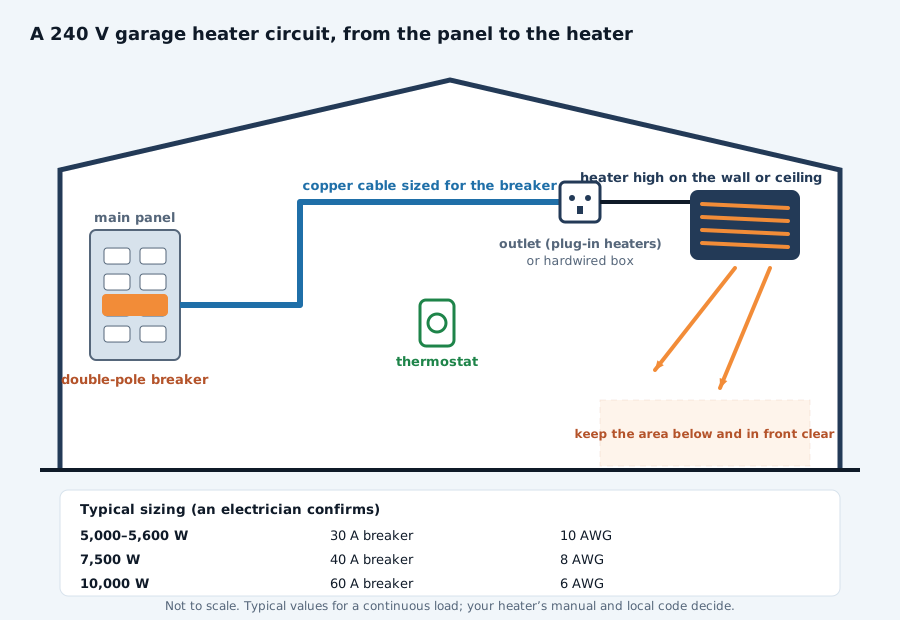
| Heater output at 240 V | Current (arithmetic) | Typical breaker and copper wire |
|---|---|---|
| 5,000 to 5,600 W | 20.8 to 23.3 A | 30 A double-pole, 10 AWG |
| 7,500 W | 31.25 A | 40 A, 8 AWG |
| 10,000 W | 41.7 A | 60 A, 6 AWG |
Those sizes are typical practice, and an electrician will confirm them for your panel and local code. Never swap in a bigger breaker on its own, because the breaker protects the wire, and undersized wire on a big breaker can overheat inside the wall.
The guide to wiring a 240 V garage heater gives typical breaker and wire sizes for each outlet type. The DR-910F review covers the heaviest case, a 10,000 W heater that the listing says needs 6 AWG copper.
3. A loose or worn plug, outlet or connection
A plug or outlet that feels hot, looks scorched or smells of hot plastic has a poor connection. That fault can trip a breaker, or worse, start a fire without tripping anything.
Stop using the heater and have a licensed electrician check the outlet and the plug. Do not fix it with an adapter, a different plug or a dryer outlet, and do not keep running the heater while you wait.
4. The overheat cut-off has tripped
Four of the five listings name overheat protection or an automatic shut-off; the DR-910F listing does not, so check its manual. Such a cut-off kills the element when the case runs too hot, and if the fan keeps going the heater suddenly blows cool air.
- Clear dust, sawdust or anything else blocking the intake or the outlet grille
- Restore the clearances the manual lists, often about 3 ft in front of the outlet
- Check the heater is not aimed into a corner or a wall that throws heat back at it
- Let it cool fully, then restart it as the manual describes
5. The thermostat or fan mode is set wrong
A heater set below the room temperature, or switched to fan-only, blows air without heat. On the DR-988 the fan ON mode keeps air moving between heating cycles, which can feel like a cold draft.
The InoKraft has an automatic fan delay that runs the fan briefly after the heat stops, which is normal. The guide to thermostat settings explains each heater’s controls and why a built-in thermostat can switch off early.
6. The heater runs nonstop but the garage stays cold
A heater that never cycles off is usually too small for the space or losing heat through an open door. Owners of small 120 V heaters often report that 1,500 W is not enough for a garage, and the physics agree.
Measure the floor and allow roughly 10 W for each square foot if the garage is insulated, and noticeably more if it is drafty. The guide to picking the right heater size shows the numbers for one- and two-car garages.
7. A failed element, motor or switch
If power reaches the heater, the settings are right and the cut-off has reset, the fault is likely inside. Some Comfort Zone owners report units that failed early, and owners of the Dr. Infrared shop heaters mention fans that rattle.
Check the warranty before anything else. The DR-988, CZ220, DR-910F and NewAir carry a 1-year warranty, and the InoKraft listing does not state one. Do not open a hardwired heater yourself.
When it is time for an electrician
Call a licensed electrician for any repeat breaker trip you cannot trace to a shared circuit, any hot or scorched outlet, and any new 240 V circuit. The garage heater safety rules list the habits that prevent most of these problems.
Never upsize a breaker, use an adapter or run a heater from an extension cord to stop it tripping. A trip is the circuit protecting its wire, so the fix is the right circuit, fitted by a licensed electrician with a permit where required.
If the heater was the wrong choice
Sometimes the honest fix is a different heater. Our top electric garage heaters are grouped by output and supply, and the sizing and supply notes show which circuit each one needs.
The Dr. Infrared or Comfort Zone comparison weighs the plug-in DR-988 against the hardwired CZ220. For a large garage that a 5,000 W heater cannot hold, see the big-garage pick.
If your garage outgrew its heater
The Dr. Infrared DR-910F puts out 10,000 W from a wall or ceiling with a remote-controlled thermostat, enough for a big garage that smaller heaters cannot hold. It must be hardwired on a heavy circuit by a licensed electrician, and owners mention fan noise.