NewAir 120 V garage heater, bench heat only
The NewAir NGH160GA00 is on our list for one reason. It plugs into an ordinary outlet, so it works in a garage with no 240 V supply at all. It will not heat a cold two-car garage, and this review says so plainly. We did not test one, so it reads the listing and owner reports.
 No 240 V needed
Our verdict
The NewAir is a sound choice for warming the spot where you work, a small shed or a studio, as long as you expect bench heat and nothing more. It plugs into an ordinary outlet, carries an ETL certification and has a metal body with a cool-touch exterior, all in the $ band. No 1,500 W heater can warm a cold two-car garage, and owners report mixed heat output and some units that died after a couple of months. If you want the whole garage warm, plan for a 240 V heater and an electrician.
Strengths
- Plugs into an ordinary 120 V outlet
- Light and small enough to carry to the bench
- Metal housing with a cool-touch exterior
- ETL certified, with automatic shut-off
- Tilting head aims heat where you stand
Weaknesses
- 1,500 W cannot heat a cold two-car garage
- Uses nearly a whole 15 A household circuit
- Heat output gets mixed reports from owners
- Some units died after a couple of months
Buy it if
you want warmth at a workbench, in a small shed or in a one-person studio, and your garage has no 240 V outlet.
Skip it if
you expect to heat a whole one- or two-car garage in winter, or the only nearby outlet shares its circuit with lights and power tools.
Specs: NewAir NGH160GA00
| Type | Portable fan-forced ceramic heater with a tilting head |
|---|---|
| Heat output | 1,500 W (about 5,100 BTU per hour), two settings |
| Power | 120 V, 12.5 A; standard household plug |
| Thermostat | Adjustable, up to 95 °F |
| Rated area | Up to 160 sq ft (maker) |
| Safety | Cool-touch exterior, automatic shut-off, ETL certified |
| Build | Metal housing, carry handle |
| Size and weight | 8.6 × 8.6 × 10.3 in, 4.4 lb |
| Warranty | 1 year limited |
Data from the Amazon.com listing and, where marked, from the maker. Price band $: under $100. Only the price Amazon shows at checkout counts.
What 1,500 W can and cannot do
NewAir rates the NGH160GA00 at 1,500 W, which our arithmetic turns into about 5,100 BTU per hour, and says it heats up to 160 sq ft. That is the most a heater on a household 120 V outlet can give, whichever brand is on the case.
Sizing by 10 W a square foot puts 1,500 W at around 150 sq ft of insulated space. A one-car garage of roughly 264 sq ft wants 2,500 to 3,000 W, and a 576 sq ft two-car garage wants 5,000 to 6,000 W.
So this is bench heat. It warms you and the air around a workbench, a potting corner or a small, closed shed, but it cannot lift a cold two-car garage to a comfortable temperature in winter. Our guide asking whether a 120 V heater is enough for a garage sets out the numbers in full.
The outlet and the circuit
The heater plugs into a standard 120 V outlet and draws 12.5 A, or 1,500 divided by 120. A typical household circuit is rated 15 A, so the heater uses almost all of it on its own.
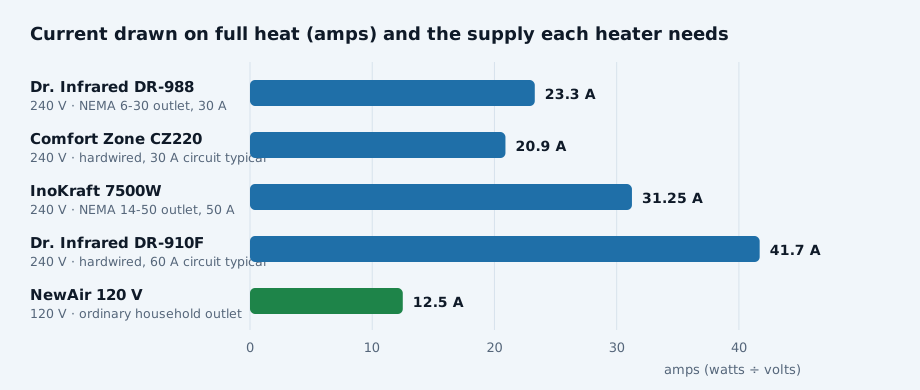
Nothing else should run on that circuit while it heats. Garage outlets often share a circuit with the lights, the door opener or a freezer, and a saw starting up on the same line is a common reason a breaker trips.
If you are unsure which outlets share a circuit, switch off one breaker and see what goes dark. When every garage outlet turns out to be shared, an electrician can add a dedicated 120 V circuit for the heater.
Plug it straight into the wall. Space heater manuals and federal safety guidance both rule out extension cords and power strips, since a thin cord or a cheap strip can overheat under a load that runs for hours.
Placement at the bench
At 8.6 × 8.6 × 10.3 in and 4.4 lb, it is small enough to carry by its handle from the bench to the car and back. The tilting head lets you aim the warm air at your legs and hands rather than at the floor.
Point it at where you stand, a few feet away, rather than trying to warm the room. Moving it with you as you change tasks gets far more comfort from 1,500 W than leaving it in a corner.
Keep it on a clear, level spot with the clearance the manual asks for, well away from sawdust, rags or anything else that can burn. Keep it clear of the gas can and the solvent shelf too, since their vapors drift along the floor.
A fan heater warms the air in front of it, and that air leaks away whenever the garage door opens. In a drafty space, our guide to infrared and fan-forced garage heaters explains why radiant heat can feel warmer at a bench.
Thermostat and heat settings
Two heat settings and an adjustable thermostat, up to 95 °F per the spec table, give you basic control. Low takes the edge off a mild day, while high is for working in the cold.
The thermostat reads air close to the heater, so in a cold garage it may run almost constantly on high. That is expected from a heater this small in a space this big, not a fault.
On the coldest days, set it to high with the thermostat near its top end while you work. Switch it off and unplug it when you finish, rather than leaving it to hold a temperature it cannot reach.
Build and safety
The housing is metal with a cool-touch exterior, the element is ceramic and the heater carries an ETL certification. A ceramic element limits its own temperature as it heats, though it still needs clearance on every side.
The listing names an automatic shut-off, but as with any portable, never cover it or dry rags on it. Keep children and pets away, and unplug it whenever you leave the garage. Our list of garage heater safety rules covers the full picture.
Electric heaters make no carbon monoxide. A running car in an attached garage is the CO risk to worry about, while a smoke or heat alarm is the sensible companion for any heater.
Running cost at the bench
An hour on high uses 1.5 kWh. At 15 cents per kWh, a figure to swap for the one on your bill, that is about 23 cents an hour. Our guide to garage heater running costs uses the same method for bigger heaters.
Low running cost per hour does not make it efficient for a whole garage. Left running all day in a space it cannot heat, it uses power without ever reaching the set temperature.
Where NewAir owners say it works
Owners describe it as reliable in sheds and studios and for warming the spot where they work. That matches what a 1,500 W heater can do.
Heat output gets mixed reports, with some saying it is not enough, which usually means it was asked to heat a whole garage. Some report cold air, and some units died after a couple of months, so keep the receipt. The warranty is 1 year limited.
When to step up to 240 V
If you want the whole garage warm, the Dr. Infrared DR-988 is our pick, with 5,600 W on a NEMA 6-30 plug, and our NewAir or Dr. Infrared comparison sets the 120 V and 240 V routes side by side.
The Comfort Zone CZ220 is the cheapest 240 V heater on our list, though it needs hardwiring. Both need an electrician if your garage lacks the circuit, a cost to weigh against years of cold mornings. Even after an upgrade, the NewAir stays useful as a spot heater for a chilly corner.
The NewAir has its no-240-V card on the homepage, and our list of the best garage heater for your outlet shows where it fits among the five.
For warm hands at the bench
If your garage has no 240 V outlet and you mostly need heat where you stand, the NewAir does that job for little money. Give it its own wall outlet, no cord or strip, and do not expect it to warm the whole garage.


