A cheap garage heater under $100, and what it gives up
Two of the five heaters we compare sit under $100, and they could hardly be more different. One is a 5,000 W ceiling heater that needs an electrician, the other a 1,500 W portable for an ordinary outlet. This page shows what each one gives up and when spending more pays you back.
What “under $100” means on this site
We never print prices, because they change often. Under $100 is our $ band and $100 to $250 is $$, while anything above $250 counts as $$$.
Two of the five heaters in our comparison of the best electric garage heaters land in the $ band. One is a hardwired ceiling heater from Comfort Zone, the other a small 120 V portable from NewAir.
They sit at opposite ends of the job. The first can heat an insulated two-car garage once it is wired in, while the second warms the spot where you stand and little more.
The two heaters in the $ band
Comfort Zone CZ220, 5,000 W on the ceiling
The Comfort Zone CZ220 is a fan-forced ceiling heater with three settings, 3,000, 4,000 and 5,000 W. On high it lists 17,065 BTU and draws 20.9 A at 240 V, and it is our budget ceiling pick.
It has a heavy-gauge steel body, two control knobs (one for the thermostat, one for the heat setting) and louvers you can aim. An overheat sensor shuts it off if it runs too hot, and the warranty covers one year.
The box holds no cord and no plug. The heater has to be hardwired to a 240 V circuit by a licensed electrician.
Comfort Zone rates it for 1,000 sq ft. Sized at a typical 10 W for every square foot of insulated floor, 5,000 W covers closer to 500 sq ft, and our Comfort Zone CZ220 review covers the rest.
NewAir NGH160GA00, 1,500 W for the bench
The NewAir 120 V garage heater plugs into an ordinary household outlet. It runs a 1,500 W ceramic element, about 5,100 BTU per hour by our arithmetic, with two heat settings and a thermostat. Its head tilts toward you.
NewAir rates it for up to 160 sq ft. It weighs 4.4 lb, has a cool-touch exterior and an automatic shut-off, and the listing says it is ETL certified.
That makes it a bench heater rather than a garage heater, because it cannot warm a cold two-car garage in winter. The NewAir 120 V review explains where it still earns a place.
The heater is cheap, the circuit may not be
A 240 V heater from the $ band can still turn into a sizable project. If your garage has no spare 240 V circuit, an electrician has to run one from the panel, and that job can cost more than the heater itself.
For a 5,000 W heater the usual result is a 30 A double-pole breaker and 10 AWG copper. Because a heater runs for hours at a stretch, the circuit gets 25 % of headroom above its draw, and your electrician confirms what your panel and local code require.
The NewAir skips all of that but has rules of its own. Its 12.5 A draw fills most of a 15 A household circuit, leaving no room for a shop light or a compressor on the same line, and the plug belongs straight in the wall.
Our guide to whether 120 V is enough for a garage sets the two supplies side by side. It also shows when a small heater makes more sense than a new circuit.
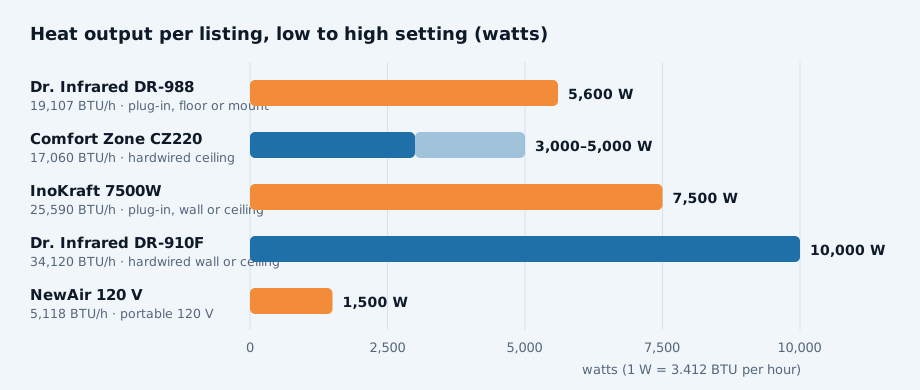
What the low price gives up
Every electric heater turns nearly all the power it draws into warmth, so a cheap one wastes no more than a costly one. The savings come out of other places.
- Heat output, since the NewAir delivers about a quarter of what the 5,600 W Dr. Infrared does
- A plug, because the Comfort Zone has none and must be wired in
- Remote and digital controls, which both $ band heaters leave out in favor of knobs and simple settings
- Long-term confidence, as owners of both mention some units failing early, a few within weeks or months
- A believable area claim, because the CZ220’s 1,000 sq ft is about double our rule of thumb
None of that makes either heater a bad buy. Plenty of owners report the Comfort Zone heating a garage or workshop well, and the NewAir gets credit in sheds and small studios.
Will a cheap heater warm your garage?
Start with the floor area. A typical insulated two-car garage of 24 × 24 ft is 576 sq ft, and at about 10 W per square foot it wants roughly 5,000 to 6,000 W.
The CZ220 on high sits at the bottom of that range, which suits an insulated two-car garage with an 8 ft ceiling. A drafty or uninsulated garage needs 12 to 15 W per square foot, so 5,000 W then covers about 330 to 420 sq ft.
A one-car garage of about 12 × 22 ft wants 2,500 to 3,000 W, close to double what the NewAir gives. Our garage heater size guide adds ceiling height and insulation to the sums.
Where the $$ band pays back
| Heater | Type | Heat output | Supply | Price band |
|---|---|---|---|---|
| Comfort Zone CZ220 | Ceiling, hardwired | 3,000 / 4,000 / 5,000 W | 240 V, 20.9 A | $ |
| NewAir NGH160GA00 | Portable | 1,500 W | 120 V outlet, 12.5 A | $ |
| Dr. Infrared DR-988 | Floor or wall/ceiling | 5,600 W | NEMA 6-30 outlet | $$ |
| InoKraft 7500W | Wall or ceiling | 7,500 W | NEMA 14-50 outlet | $$ |
| Dr. Infrared DR-910F | Wall or ceiling, hardwired | 10,000 W | 240 V, about 42 A | $$$ |
The homepage comparison table also lists the controls and mounting of all five heaters, along with each maker’s rated area.
The Dr. Infrared DR-988, our top pick, costs more than the Comfort Zone but needs only a NEMA 6-30 outlet, and it works on the floor or mounted high on its bracket. If your garage already has that outlet, it saves the hardwiring step.
The InoKraft 7500W uses the 50 A NEMA 14-50 outlet many garages have for an EV charger or an RV. The DR-910F suits a big garage, with 10,000 W and a remote thermostat.
Cheap traps to skip
Never feed a 240 V heater through an adapter, an extension cord or a dryer outlet borrowed for the winter. If the outlet is wrong, a licensed electrician adds the right one, with a permit where your area requires it.
Skip a second 1,500 W heater on the same household circuit as well. Two of them draw about 25 A, far more than a 15 A breaker allows, and it will trip again and again.
Avoid no-name heaters with no safety mark on the label. The DR-988 is UL and C-UL listed and the NewAir is ETL certified, so look for a UL, ETL or CSA mark on whatever you buy.
A cheap heater is only as safe as the way you use it. Keep it well away from gas cans and paint solvents, whose vapors sink and gather near the floor, and leave the clearances the manual asks for.
Never cover a heater or dry rags on it, and unplug a portable when you leave the garage.
Our pick if you want to spend the least
For a whole garage, the Comfort Zone CZ220 is the $ band heater we would choose, 5,000 W on the ceiling with three settings. Budget for an electrician to wire it in, and read its 1,000 sq ft claim as nearer 500.
