What size electric heater your garage needs
Most people pick a garage heater by the area printed on the box, and most of those areas are generous. This guide shows how to work out the watts your garage needs from its floor area, allowing for ceiling height and insulation, and how the five heaters we compare line up against that number.
Watts are the number to size by
Electric garage heaters are rated in watts (W), the heat they deliver on their top setting. Almost every watt a heater draws ends up as heat in the room, so a 5,000 W heater gives about 17,100 BTU per hour whatever the brand.
Sizing is therefore a matter of matching watts to the heat your garage loses on a cold day. The label cannot tell you that figure, but your floor area gets you close once you allow for ceiling height and insulation.
The 10 watts per square foot rule
Garage sizing usually starts from a rule of thumb, roughly 10 W for each square foot of floor in an insulated garage with an 8 ft ceiling. It is a starting point rather than a law, and it assumes a garage door that closes and seals reasonably well.
An uninsulated or drafty garage, or one with a tall ceiling, wants more, usually 12 to 15 W per square foot. A detached garage with bare stud walls and an old steel door sits at the top of that range.
| Space | Floor area | Insulated (10 W per sq ft) | Uninsulated (12–15 W per sq ft) |
|---|---|---|---|
| Shed or bench corner, 10 × 16 ft | 160 sq ft | about 1,600 W | about 1,900–2,400 W |
| One-car garage, 12 × 22 ft | 264 sq ft | about 2,500–3,000 W | about 3,200–4,000 W |
| Two-car garage, 24 × 24 ft | 576 sq ft | about 5,000–6,000 W | about 6,900–8,600 W |
| Three-car garage, 24 × 36 ft | 864 sq ft | about 8,600 W | about 10,400–13,000 W |
The figures are plain arithmetic from the rule, rounded. Measure your own floor inside the walls, multiply length by width, then multiply by the watts per square foot that matches your garage.
What pushes the number up
- The garage door: an uninsulated steel door and the gaps under it lose more heat than anything else
- The ceiling: warm air rises, so an open or bare ceiling lets it escape into the roof
- Height: a ceiling well above 8 ft means more air to warm before you feel it at the bench
- Outdoor cold: the colder the day, the longer any heater has to run to hold its setting
- Door use: each time the big door goes up, most of the warm air leaves with it
Insulation costs less than extra watts over a few winters. A bottom seal and weatherstripping on the door can move a garage from the top of the range toward the bottom, and the garage insulation guide sets out which jobs to tackle first.
The five heaters by heat output
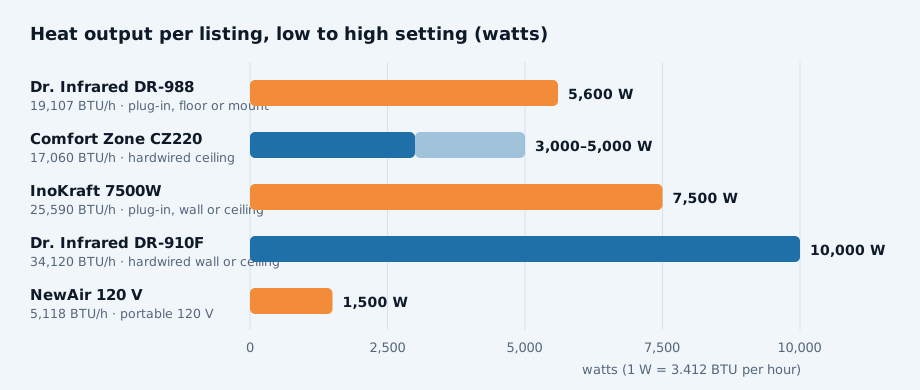
The chart shows each heater’s output from its listing, with the Comfort Zone’s lower settings marked. The table beside it compares the maker’s rated area with what the rule of thumb suggests.
| Heater | Output | Maker’s rated area | Insulated floor by our rule |
|---|---|---|---|
| Dr. Infrared DR-988 | 5,600 W (about 19,100 BTU/h) | 600 sq ft | about 560 sq ft |
| Comfort Zone CZ220 | 3,000, 4,000 or 5,000 W | 1,000 sq ft | about 500 sq ft |
| InoKraft 7500W | 7,500 W (about 25,600 BTU/h) | up to 750 sq ft | about 750 sq ft |
| Dr. Infrared DR-910F | 10,000 W (about 34,100 BTU/h) | not given on the listing | about 1,000 sq ft |
| NewAir NGH160GA00 | 1,500 W (about 5,100 BTU/h) | up to 160 sq ft | about 150 sq ft |
Makers’ coverage figures lean optimistic. Comfort Zone’s 1,000 sq ft for a 5,000 W heater is twice what the rule suggests, so in a cold climate plan on about half that.
A worked example
Take a detached two-car garage of 22 × 24 ft, so 528 sq ft. With insulated walls and a bare ceiling, 12 W per square foot is a fair middle guess, which gives about 6,300 W.
A 5,600 W heater would cope on most days and run long on the coldest ones. Insulating the ceiling would bring the need down near 5,300 W, and a 7,500 W unit would leave a comfortable margin either way.
Why bigger is not automatically better
An oversized electric heater warms the garage fast and then cycles on and off, which does it no harm. The cost shows up in the wiring, because more watts mean a larger breaker and thicker cable.
A 5,600 W heater typically calls for 10 AWG copper on a 30 A breaker, while a 10,000 W unit usually needs 6 AWG on 60 A. That may be more than an older panel can spare, and our 240 V wiring guide explains what an electrician will check.
Running cost follows the heat your garage loses, not the size of the heater. Two heaters holding the same setting in the same garage use roughly the same kWh over a day, as the running cost guide shows with the arithmetic.
When 1,500 W is all you have
Without a 240 V supply, the largest heater you can run is a 1,500 W model on an ordinary household circuit. That is about 5,100 BTU per hour, enough for a bench or a small shed but not for a cold two-car garage.
Whether that trade suits your garage is the subject of our guide to 120 V or 240 V heaters, which looks at what a household outlet can and cannot do.
Matching size to your garage
- Insulated one-car garage: about 2,500 to 3,000 W, such as the Comfort Zone CZ220 on its 3,000 W setting
- Insulated two-car garage: about 5,000 to 6,000 W, the size of the Dr. Infrared DR-988
- Drafty or uninsulated two-car garage: 7,500 W, or insulation work before a bigger heater
- Three-car garage or tall workshop: about 10,000 W, such as the Dr. Infrared DR-910F
- A bench or small shed only: a 1,500 W heater on its own 120 V circuit
All five sit side by side in our comparison of the best electric garage heater options, with the sizing basics under how sizing works and every rated output in the comparison table.
For an insulated two-car garage of average size
The Dr. Infrared DR-988 puts out 5,600 W, close to what the rule of thumb asks for a 24 × 24 ft insulated garage. It plugs into a NEMA 6-30 outlet, so you will need one added by an electrician if your garage lacks it.