Help your garage heater by insulating first
A heater replaces the heat your garage loses, so every gap you close is heat you no longer pay for. Start with the big door and the ceiling, and a modest 240 V heater can do work that would otherwise need a far bigger one.
Where a garage loses its heat
Most garages were built to keep rain off a car, not to stay warm. Thin walls, a bare ceiling and a huge door make them leak heat far faster than the rooms of a house.
- The garage door, usually the weakest part, through its panels and the gaps around it
- The ceiling or roof, where warm air collects and escapes
- Uninsulated outside walls, especially on a detached garage
- Gaps at the sill plate and side door, and around windows
- The concrete slab, which stays cold and soaks up heat from your feet
An attached garage shares a wall with the house, which helps a little. A detached garage has four outside walls, so it usually needs more heat per square foot and gains more from insulation.
Start with the garage door
In a typical garage, a bare steel door with daylight showing beneath it leaks more warmth than any wall or window. Fixing it is also the cheapest job on the list, and most of it needs only basic hand tools.
- Replace a cracked or flattened bottom seal so it meets the floor along its full width
- Add weatherstripping along the sides and top of the door frame
- Fit a door insulation kit to the panels, or plan for an insulated door later
- Seal the side door with the same care as the door to the house
Close the door and look for daylight along the edges after dark with a light on outside. Any glow you see is a gap where cold air comes in and warm air leaves.
The ceiling comes next
Heat rises, so warm air from a fan heater gathers under the ceiling first. If the ceiling is bare drywall under a cold attic, or open rafters under the roof, much of what you paid for drifts straight out.
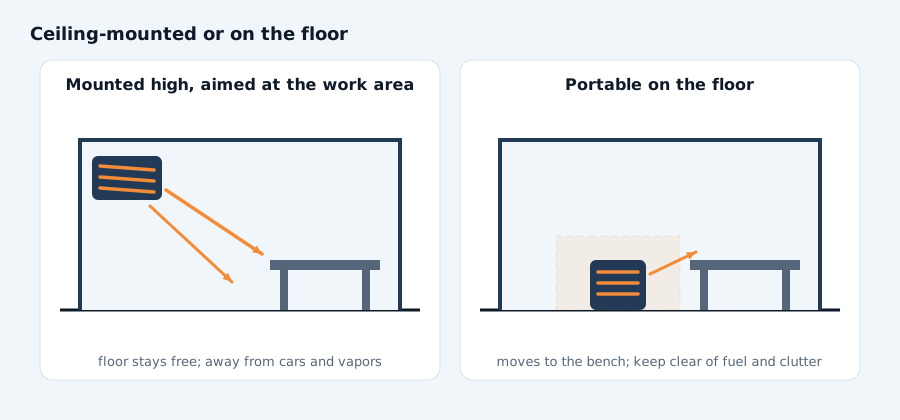
A ceiling-mounted heater aimed at an angle pushes warm air back down to where you stand. The guide to mounting a garage heater covers the angle and the clearances, while insulation above stops the ceiling from stealing that air in the first place.
Keep insulation and anything else that can burn clear of the heater by the distances in its manual. A heater mounted high still needs open space around it, so plan the bracket position before you staple up any batts.
Walls, gaps and the slab
Open stud walls can take batts or rigid board, then a covering to protect them from bumps. Finished walls are harder, so seal outlets, the sill plate and window frames first, since drafts often matter more than the wall itself.
The slab is the hardest surface to fix. A rubber mat or a wooden platform at the bench keeps your feet off cold concrete and makes the air temperature you set feel warmer.
R-value in plain terms
R-value measures how well a material resists heat flow, and higher numbers resist more. It is printed on batts and board, and on door kits too, so you can compare products by the same scale.
What counts most is covering the largest leaks completely. A modest R-value over the whole door and ceiling beats a thick layer on one wall while the door gaps stay open.
How much smaller the heater can be
One widely used rule of thumb asks for roughly 10 W of heat for every square foot when the space is insulated and the ceiling sits at 8 ft, rising to 12 to 15 W where it is bare or drafty. It is a guide, not a law.
| Garage | Floor area | Insulated, about 10 W per sq ft | Uninsulated, 12 to 15 W per sq ft |
|---|---|---|---|
| One-car, about 12 × 22 ft | 264 sq ft | about 2,600 W | about 3,200 to 4,000 W |
| Two-car, about 24 × 24 ft | 576 sq ft | about 5,800 W | about 6,900 to 8,600 W |
Those figures are arithmetic from the rule. Insulating a two-car garage can move it from needing a 7,500 W or bigger heater on a 40 A circuit to a 5,000 to 5,600 W heater on a typical 30 A circuit, which an electrician will confirm for your panel.
The full method, with ceiling height and climate, sits in the guide to choosing the right heater size. Makers’ “heats up to” areas are optimistic, so trust the rule over the box.
What insulation does to the bill
Less heat lost means fewer minutes each hour with the element on, and that is where the savings come from. The guide to what a garage heater costs to run walks through kW × hours × rate with worked figures.
A tight garage also holds a frost-guard setting cheaply. Keeping it at about 40 to 50 °F between projects keeps stored paint and batteries safe, and the thermostat guide shows how to set each heater for it.
An electric heater adds no moisture and makes no carbon monoxide, so sealing the garage does not create a fume risk from the heater. The real hazard is fuel vapor. Gasoline and solvent fumes collect low, so keep heaters away from where you fuel or spray.
Choosing the heater once the garage is sealed
A sealed, insulated two-car garage suits a 5,000 W ceiling heater such as the Comfort Zone CZ220. Its maker rates it for 1,000 sq ft, which is generous; by the rule of thumb it fits nearer 500 sq ft in an insulated garage.
The Comfort Zone CZ220 review covers its hardwired install and three heat settings. To weigh it against the plug-in options, see which garage heater to buy, or jump to the budget ceiling pick and the sizing and supply notes.
If your garage is sealed and insulated
The Comfort Zone CZ220 gives 3,000, 4,000 or 5,000 W from the ceiling, keeping the floor clear for the car and the bench. It must be hardwired by a licensed electrician, and owners give mixed reports on noise, but in a tight two-car garage it is a sensible budget choice.