7,500 W or 10,000 W, a heater for a big garage
Both hang on a wall or ceiling, push air through adjustable louvers and come with a remote. The InoKraft plugs into a 50 A outlet, while the Dr. Infrared DR-910F is hardwired, gives a third more heat and sits a band higher.
The InoKraft up to about 750 sq ft, the DR-910F beyond that
If your garage is a large two-car or a modest three-car with decent insulation, the InoKraft 7500W is likely enough. It plugs into a NEMA 14-50 outlet, so there is no hardwiring if that outlet is already in place.
The Dr. Infrared DR-910F is for a big shop, a tall ceiling or a garage you cannot insulate well. Its 10,000 W needs a dedicated hardwired circuit, which means an electrician, a heavier wire and more panel capacity.
Both appear in our garage heater comparison, the InoKraft as pick 3 and the DR-910F as the big-garage pick. The InoKraft also meets the 5,600 W DR-988, and the DR-910F faces the hardwired Comfort Zone.
InoKraft 7500W and DR-910F side by side
Every figure comes from the Amazon.com listings, with the makers’ area claims marked. Dr. Infrared gives no area figure for the DR-910F, so that row uses the common 10 W per square foot rule and says so.
| Feature | InoKraft 7500W | Dr. Infrared DR-910F |
|---|---|---|
| Type | Fan-forced, wall or ceiling, cord and plug | Fan-forced, wall or ceiling, hardwired |
| Heat output | 7,500 W on high (about 25,600 BTU per hour), plus low and ECO | 10,000 W (about 34,100 BTU per hour), single phase |
| Current draw | 31.25 A | 42 A in the spec table (41.7 A by arithmetic) |
| Supply needed | NEMA 14-50 outlet, 50 A | Dedicated 240 V circuit, typically 60 A with 6 AWG copper |
| Install | 8.2 ft cord with a NEMA 14-50P plug; listing asks for a professional electrician | No cord; hardwired by an electrician, 6 AWG copper per listing |
| Mounting | Five angles, adjustable louvers | Bracket, five adjustable louvers |
| Thermostat and controls | Remote control, digital thermostat from 40 to 99 °F, timer up to 24 h | Remote-controlled thermostat 50 to 85 °F, timer, one fan speed |
| Rated area | Up to 750 sq ft (maker) | Not stated; about 1,000 sq ft insulated by the rule of thumb |
| Size and weight | 24.9 lb; 17.71 × 15.74 × 15.15 in | 22 × 18 × 16 in, 49 lb |
| Price band | $$ | $$$ |
| Warranty | Not stated on the listing | 1 year limited, parts and labor |
Heat and the size of your garage
Allowing 10 W a square foot in an insulated space, the InoKraft covers roughly 750 sq ft and the DR-910F roughly 1,000 sq ft. A drafty space or a ceiling above 8 ft pushes the need to 12 to 15 W, which trims both figures by a sixth to a third.
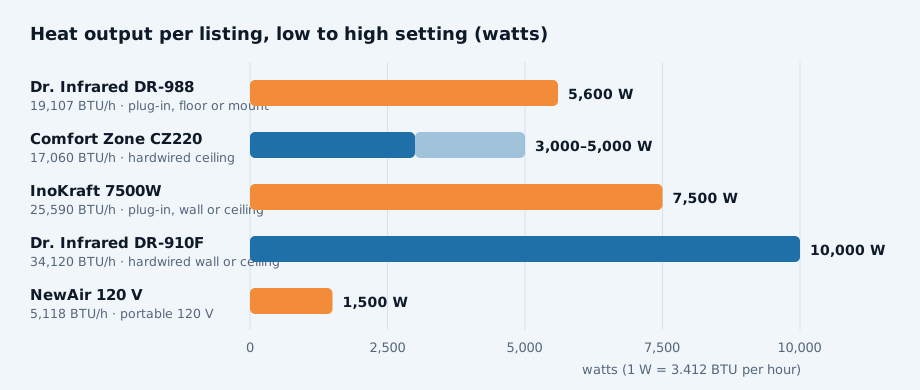
So the gap is a third more heat, not double. Before you buy the bigger one for an uninsulated shop, price a door seal and some ceiling insulation, as our guide to insulating a garage first suggests. Our sizing guide does the sums for your floor.
Round goes to the DR-910F, for big or cold spaces.
A 50 A plug or a hardwired 60 A circuit
The InoKraft is the simpler job when a NEMA 14-50 outlet already exists, since it plugs straight in. Its listing still calls for a professional electrician, and if the outlet also serves an EV charger, the two cannot run together.
The DR-910F has no cord at all. At about 42 A it is a continuous load, so general practice puts it on a 60 A double-pole breaker with 6 AWG copper, the gauge the listing names. A licensed electrician confirms your panel can spare that much and pulls a permit where required.
Our 240 V wiring guide shows typical breaker and wire sizes for each heater class, as a starting point for that conversation.
Round goes to the InoKraft, for the easier hookup.
Hanging 24.9 lb or 49 lb
Both mount high and aim their air with louvers. At 24.9 lb the InoKraft is a modest load for a wall bracket, while the DR-910F weighs 49 lb and wants solid framing under its bracket.
Angle either one toward where you work rather than straight at the floor, and keep the clearances in the manual. Neither belongs above the corner where the mower gets filled or paint gets sprayed, since those vapors sink and pool low.
Round goes to the InoKraft, at about half the weight.
Two remote thermostats, two ranges
Each comes with a remote and a timer. The InoKraft’s digital thermostat spans 40 to 99 °F and adds an ECO mode that trims output as the space warms, which suits holding a garage at a frost-safe 40 to 50 °F.
The DR-910F’s remote thermostat runs from 50 to 85 °F with one fan speed. Owners of the Dr. Infrared shop heaters say the thermostat is not always accurate and that the air can feel cool at times, possibly the fan moving air while the element cycles off.
Round goes to the InoKraft, for the wider range and ECO mode.
Noise, build and running cost
InoKraft lists 65 dB, and owners describe it as quiet and well built. Dr. Infrared fits a heavy-duty, fully enclosed motor with UL and cUL listings, yet owners report a noisy fan and rattles on the shared review pool.
Running cost follows the watts. Flat out, the DR-910F uses 10 kWh an hour, which at 15 cents per kWh comes to 150 cents, against about 113 cents for the InoKraft. Use your own bill’s rate, and see our running-cost guide for how the thermostat cuts that.
Round goes to the InoKraft on both noise and cost per hour.
Price band and track record
The InoKraft sits in the $$ band, between $100 and $250, and the DR-910F in the $$$ band, over $250. Add the cost of a 60 A circuit and the gap widens further.
Dr. Infrared states a 1-year parts and labor warranty and has a long record on Amazon. The InoKraft is a younger listing with fewer owner reports and no stated warranty.
Round goes to the DR-910F for its stated warranty and longer record.
The InoKraft has a short record and no stated warranty, and it may have to share a 50 A outlet with a car. The DR-910F needs a hardwired 60 A circuit that not every panel can spare, and owners describe its fan as loud.
Enough heat, or plenty
For a well-sealed garage up to about 750 sq ft with a 14-50 outlet, the InoKraft does the job with less fuss. For a big shop, a tall ceiling or thin walls, the DR-910F has the extra heat, as long as your panel can carry it.