Infrared or fan-forced, which garage heater warms you
A fan-forced heater heats the air and blows it through the garage, while a radiant infrared heater warms the people and things it faces. Which one suits you depends on how drafty the garage is and whether you heat the whole space or one bench.
Two ways to move heat
A fan-forced heater, also called forced-air, blows air across a hot metal coil or ceramic element. The warm air spreads through the garage, raising the temperature of the whole space until the thermostat switches off.
An infrared heater works more like the sun. It sends radiant heat in a line to the surfaces it faces, so your hands and the bench warm up even while the air around them stays cool.
A name that confuses buyers
Dr. Infrared Heater is a brand name, not a description of how its shop heaters work. The DR-988 and the DR-910F on this site are fan-forced heaters, with a fan pushing air over the element like the Comfort Zone and InoKraft.
Most of the 240 V heaters people buy for a garage are fan-forced, with coil or ceramic elements. Read the listing for the words “fan-forced” or “radiant” rather than trusting the name on the box.
Side by side
| Question | Fan-forced | Radiant infrared |
|---|---|---|
| What it heats | The air, then everything in the room | People and objects in its line of sight |
| Best space | A closed, insulated garage | A drafty shop or one work spot |
| Open door | Warm air is lost and must be rebuilt | Heat on you continues while the air escapes |
| Whole-garage warmth | Yes, given enough watts | Patchy outside the beam |
| Noise | Fan noise, more on some models | Usually quiet, no fan on many units |
| Thermostat | Reads air temperature, works as expected | Air reading can lag behind how warm you feel |
When fan-forced wins
If you want the whole garage warm, so paint dries and you can walk from bench to car without feeling the chill, fan-forced is the usual choice. It heats a closed space fast and holds it steady.
It works best once the door is sealed and the ceiling insulated, because the warm air stays put. Open the big door and that air leaves, so the heater has to start again after the car comes in.
The Dr. Infrared shop heaters draw owner praise for strong output relative to their size. Fan noise and rattles come up too, which matters more if you listen to music or talk on the phone while working.
When radiant wins
Radiant heat suits a garage you cannot seal, one where the door opens often, or a large shop where you only need warmth at a single bench. It warms you directly, so a draft does less to cancel it.
It is weaker for the whole room. Step out of the beam and the cold returns, and things outside its line of sight, such as pipes behind a cabinet, may still freeze on a hard night.
Mounting changes the picture
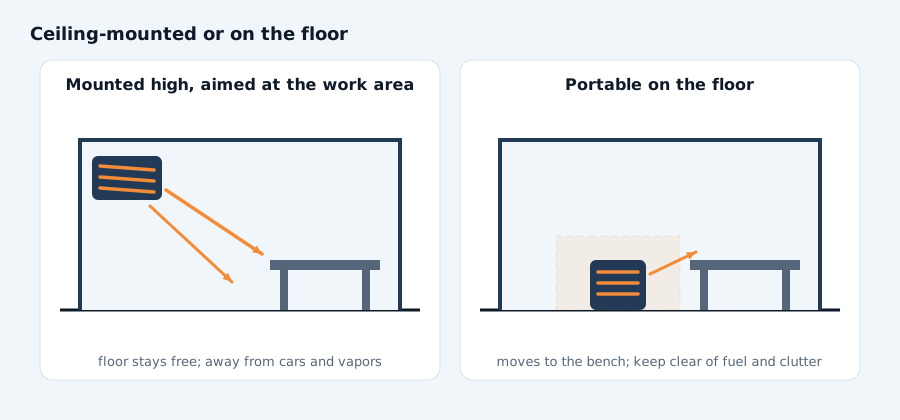
A fan-forced heater mounted high and angled down pushes warm air back toward the floor, while one on the floor heats the space around it first. Radiant units are usually aimed straight at the work area from a wall or ceiling.
Either way, keep the clearances in the manual and keep the heater away from gasoline and solvent vapors, which collect low. The guide to where to mount a garage heater covers angles and heights for each type.
Thermostats behave differently
A fan-forced heater’s thermostat reads the air it moves, so it can switch off a little early because it sits in its own warm air stream. A wall thermostat away from the heater regulates better on hardwired units that support one.
With radiant heat you can feel warm while the air reads cold, so an air thermostat may keep the heater running longer than needed. The guide to setting a garage heater thermostat explains how to work around both.
Size matters with either type
Neither type escapes the watts. A 1,500 W unit of any kind warms a bench, not a cold two-car garage. The guide to whether a 120 V heater is enough shows where the household outlet runs out.
For whole-garage heat, start with the floor area, then budget about 10 W per square foot when walls and ceiling are insulated. The guide to sizing an electric garage heater takes you through it step by step.
Safety rules apply to both
Radiant and fan-forced heaters both turn electricity into heat with no flame and no exhaust, so neither makes carbon monoxide. They share the same risks, from hot surfaces and blocked clearances to the supply circuit.
A radiant panel aimed at a stack of rags or a cardboard box heats that target directly, so watch what sits in its beam. A fan-forced unit pulls in sawdust, so clean its intake grille through the winter.
Any 240 V heater, whatever its type, needs its own circuit fitted by a licensed electrician. Never run one through an adapter or extension cord to reach a better spot.
What we would choose for a workshop
For most home workshops in a closed garage, a fan-forced 240 V heater gives the most even warmth. Our best heater for a garage workshop is a fan-forced unit, the Dr. Infrared DR-988, which gives 5,600 W from the floor or from a high bracket.
The DR-988 review covers its NEMA 6-30 plug and fan modes along with the noise owners mention, and the guide to garage heater brands explains who stands behind each name. The five picks and the comparison table set each heater’s type and output beside the supply it needs.
For even warmth across the garage
The Dr. Infrared DR-988 is fan-forced despite its brand name, and its 5,600 W suits a typical insulated two-car garage. It needs a dedicated 240 V, 30 A outlet, and owners mention fan noise, but it heats the space rather than one spot.