Where to mount an electric garage heater
Where a garage heater goes decides how warm you feel at the bench, how much floor you keep and how far it sits from fuel vapors. This guide compares ceiling, wall and floor placement and shows which of the five heaters we compare suits each one.
Three places a heater can go
A garage heater can hang from the ceiling, sit high on a wall or stand on the floor. The right choice depends on the heater, on where you work and on how the garage is used day to day.
| Heater | Mounting options | Aiming the air | Connection |
|---|---|---|---|
| Dr. Infrared DR-988 | Floor, or wall or ceiling bracket | Set by where you place or mount it | NEMA 6-30 plug |
| Comfort Zone CZ220 | Ceiling | Adjustable angle and louvers | Hardwired |
| InoKraft 7500W | Wall or ceiling | Five angles, adjustable louvers | NEMA 14-50 plug |
| Dr. Infrared DR-910F | Wall or ceiling | Five adjustable louvers | Hardwired |
| NewAir NGH160GA00 | Floor or bench | Tilting head | 120 V plug |
Why mounting high works
A heater up high frees the floor and stays out of reach of children and passing cars. It also sits well above the gasoline and solvent vapors that collect low, which is the biggest safety gain.
Warm air rises, so a mounted heater has to push it down to where you stand. Aim it at the work area at an angle, using the bracket and the louvers, rather than straight down at the floor.
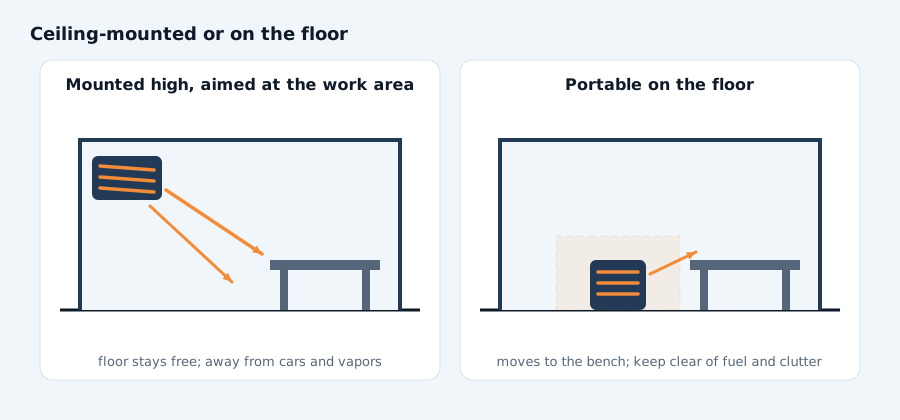
On the ceiling
A ceiling heater uses space nothing else needs. The Comfort Zone CZ220 is built for it, with a bracket, an adjustable mounting angle and louvers, and it is hardwired, as our CZ220 review explains.
Fix the bracket into solid framing that can carry the weight, following the manual. The CZ220 weighs 20.4 lb, while the DR-910F weighs 49 lb, which calls for a sturdy spot.
Keep the heater clear of the garage door’s travel and the opener rail, and away from the roof of a parked car or a lifted hood. A ceiling heater blows warm air that will rise again, so an insulated ceiling pays off, as our guide to insulating the garage first shows.
High on a wall
A heater high in a corner, aimed across the garage toward the bench, spreads warm air along the floor where you work. Wall mounting also keeps the controls closer to reach than a ceiling unit.
The InoKraft 7500W mounts on a wall or ceiling with five angles and a remote, as our InoKraft 7500W review covers. Its 8.2 ft cord means the 50 A outlet has to sit within reach of the mounting spot.
Plan the outlet or junction box with the mounting spot in mind. Our guide to 240 V garage heater wiring covers what your electrician needs to know before running the circuit.
On the floor
The Dr. Infrared DR-988 and the NewAir both work as portables. A floor heater can move to the bench or the car you are working on, and you can roll it aside when you need the space.
The drawbacks are real. A floor heater sits where vapors gather, takes up space, and puts a cord where you walk, so keep about 3 ft in front of it clear and unplug it when you leave.
The DR-988 offers a middle path. It can start life on the floor while you find the spot that warms the bench best, then move onto its bracket once you know where it belongs.
Spots to avoid
- Directly above the workbench, where hot air blows on your head and the bench stays cool
- Next to the big door, where much of the warm air leaves each time it opens
- Facing a wall a few feet away, which bounces heat back into the heater’s thermostat
- Over shelves of paint, fuel cans or solvent bottles
- Behind a car, where the heater blows into the bumper instead of the room
In most two-car garages the better spot is a back corner or the side wall opposite the bench. From there the air crosses the room and reaches the work area before it rises.
Fan-forced or radiant changes the aim
A fan-forced heater warms the air and pushes it around, so its exact spot matters less in a closed garage. A radiant heater warms what it faces, so it must point at you.
Most heaters on this site are fan-forced. If you mostly want warmth at one bench in a drafty space, our guide to infrared or fan-forced heaters compares the two approaches.
A placement checklist
- Away from where you fuel, spray paint or use solvents
- Clear of the door track, the opener rail and parked cars
- Tilted toward the bench rather than pointed at the floor
- Within cord reach of the outlet, or where the electrician can run the circuit
- Controls within reach, or a heater with a remote
- The manual’s clearances kept free of anything that can burn
A built-in thermostat sits in the heater’s own air stream and can read high, so a heater blowing straight at a nearby wall may switch off early. A hardwired heater can often use a wall thermostat placed away from it instead.
Once it is up, our garage heater safety rules cover the habits that keep it safe. All five heaters appear in our garage heater picks, with the ceiling heater at pick two and every mounting option in the heater list.
For a heater that lives on the ceiling
The Comfort Zone CZ220 is made for the ceiling, with an adjustable angle and louvers to aim 5,000 W at your work area. It must be hardwired by an electrician; if you want a plug and a remote, the InoKraft 7500W mounts high too.