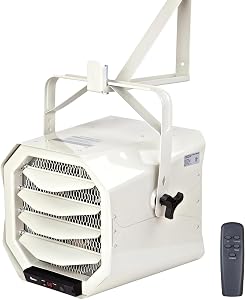
Dr. Infrared DR-988, the garage heater we would pick
The DR-988 is the heater we would put in an insulated two-car garage. It has the right output for that space, plugs into one 240 V outlet instead of being wired in, and works on the floor or up on a bracket. We did not test one, so this review weighs the listing against what owners report.
 Our top pick
Our verdict
The DR-988 is the heater we would choose for a typical insulated two-car garage, because 5,600 W matches that space and one NEMA 6-30 outlet is all it needs. It runs on the floor or mounts high and holds UL and C-UL listings. Dr. Infrared also has a long Amazon track record. You still need a dedicated 240 V, 30 A outlet, which means an electrician if you lack one. Owners mention fan noise, the built-in thermostat reads its own air stream, and the review pool mixes several Dr. Infrared models.
Strengths
- 5,600 W, the right size for an insulated two-car garage
- Plugs into a NEMA 6-30 outlet, no hardwiring
- Floor use or wall and ceiling mounting
- All-metal housing with a steel grille, listed by UL and C-UL
- Fan switch with constant ON and AUTO modes
Weaknesses
- Needs a dedicated 240 V, 30 A outlet
- Thermostat sits inside the heater and can read off
- Fan noise and rattles come up in owner reports
- Listing gives two different thermostat upper limits
- Owner reviews are shared across several Dr. Infrared models
Buy it if
you heat an insulated one- or two-car garage, have or will add a NEMA 6-30 outlet, and want a heater you can use on the floor or hang from the ceiling.
Skip it if
your garage has no 240 V supply and you will not pay an electrician, or you want a near-silent heater for a room you sit in for hours.
Specs: Dr. Infrared DR-988
| Type | Fan-forced 240 V shop heater; floor unit, or wall or ceiling mount |
|---|---|
| Heat output | 5,600 W (about 19,100 BTU per hour) |
| Power | 240 V, about 23 A; the spec table rates it for a 30 A circuit |
| Plug | 6 ft cord with a NEMA 6-30P plug; needs a dedicated NEMA 6-30R 30 A outlet |
| Thermostat | Adjustable; the title says 37 to 113 °F, the spec table 37 to 95 °F |
| Fan | ON (constant) or AUTO (runs with the heat) |
| Rated area | 600 sq ft (maker) |
| Build | All-metal housing, steel safety grille, aluminum fan blades, cord storage |
| Safety | Automatic overheat cut-off; UL and C-UL listed |
| Warranty | 1 year limited, components |
Data from the Amazon.com listing and, where marked, from the maker. Price band $$: $100 to $250. Only the price Amazon shows at checkout counts.
5,600 W against a two-car garage
Dr. Infrared rates the DR-988 at 5,600 W, which works out at about 19,100 BTU per hour by our arithmetic. The spec table claims a heating coverage of 600 sq ft, a figure from the maker rather than a measurement.
Garage sizing usually starts from roughly 10 W for each square foot of insulated floor under an 8 ft ceiling. A 24 × 24 ft two-car garage is 576 sq ft, so it wants roughly 5,000 to 6,000 W, and the DR-988 lands in the middle of that range.
An uninsulated or drafty garage needs 12 to 15 W per square foot. There the same heater suits something nearer 375 to 470 sq ft, so a one-car bay or a large single stall. Our guide to sizing a heater for your garage walks through the numbers for your space.
The outlet, breaker and wire it needs
Out of the box you get a 6 ft lead ending in a NEMA 6-30P plug. It wants its own NEMA 6-30R receptacle, which the listing specifies at 250 V and 30 A, the 240 V socket with two flat blades and a ground.
At 240 V the heater pulls about 23.3 A (5,600 ÷ 240). Heaters are treated as continuous loads, which means sizing the circuit at 125 % of the draw or more. The typical result is a 30 A double-pole breaker fed by 10 AWG copper, which your electrician will confirm.
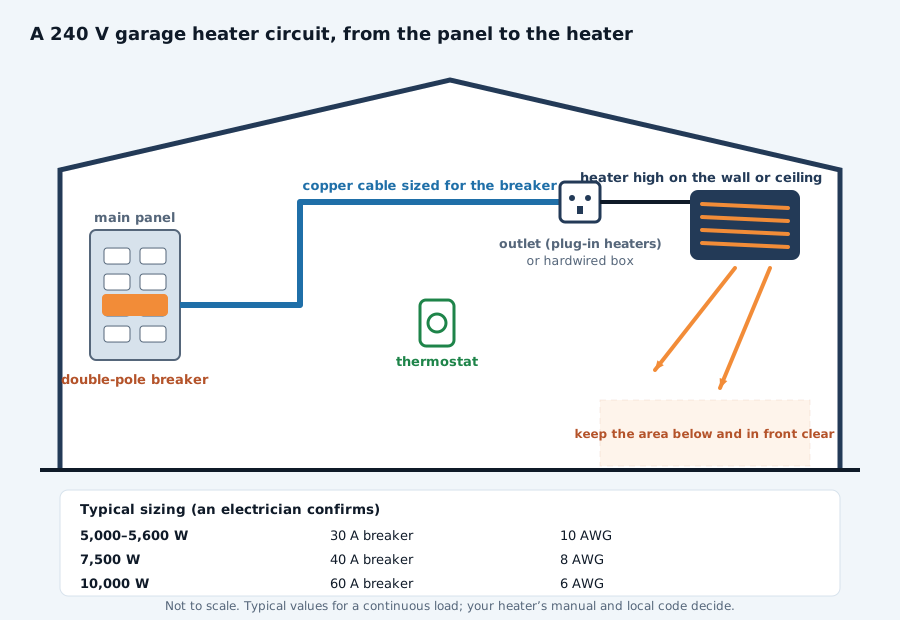
If the outlet is already on the wall, setup is a matter of plugging in. If not, a licensed electrician adds the circuit and outlet, with a permit if your town requires it. What that job involves is laid out in our 240 V garage heater wiring guide.
Never reach for an adapter, an extension cord or a dryer outlet to skip that step. A heater this size runs for hours at a time, and a borrowed circuit or a thin cord is where the heat ends up in the wrong place.
On the floor or mounted high
Most garage heaters force a choice between portable and fixed. The DR-988 sits on the floor as a portable unit, or goes onto a wall or ceiling with the bracket the listing describes, and the built-in cord storage keeps the 6 ft lead tidy when you move it.
Mounted high, it frees the floor and keeps the hot grille away from cars and sawdust. Tilt it toward the bench or car bay instead of pointing it straight down at the slab, and keep the clearance the manual asks for in front of the outlet.
On the floor it can stand right beside a bench. Keep it well clear of the corner where the mower gets refueled or where you spray, since those vapors are heavier than air and gather low, close to a heater’s hot element.
Thermostat and fan modes
The adjustable thermostat sits in the heater. The listing title gives a range of 37 to 113 °F while the spec table says 37 to 95 °F, so the listing carries two different upper limits. Either way, the low end lets you hold a garage just above freezing.
A thermostat inside the casing reads the air the heater has just warmed, so it can shut off before the far corner is comfortable. Owners of the Dr. Infrared shop heaters give mixed reports on its accuracy, and our guide to thermostat settings for a garage heater covers how to work around that.
A fan switch offers ON, where the fan runs all the time, and AUTO, where it runs with the heat. AUTO saves a little power and noise, while ON keeps the air moving and evens out a tall garage.
Build, noise and safety
The housing is all metal in red, with a steel safety grille and aluminum fan blades. That is a shop heater built for a garage floor, not a plastic room heater dressed up for one.
Noise is the common complaint. Owners mention fan noise and, on some units, rattles, which matters more in a hobby room than in a working garage. A rattle often comes from a loose bracket or panel screw, so check the fixings before you write the heater off.
An automatic overheat cut-off is built in, and the heater carries UL and C-UL listings. It makes no fumes or carbon monoxide, but it needs the manual’s clearances and must never be covered, and you should pull the plug whenever you go indoors. Our garage heater safety rules cover the rest.
What it costs to run
Running cost is power times hours times your rate. Flat out for an hour the DR-988 uses 5.6 kWh, so at 15 cents per kWh that hour costs about 84 cents. Use the rate on your own bill, since it varies a lot by state.
In practice the thermostat cycles the heater, so real use depends on insulation and the weather outside. Holding a garage at 45 °F costs far less than 65 °F, and sealing the door bottom often saves more than any setting.
What Dr. Infrared shop heater owners report
One caveat comes first. The Dr. Infrared shop heaters share one Amazon review pool with several models on the same listing, so owner reports mix the DR-988 with its siblings and cannot all be read as being about this heater.
With that caveat, owners of the Dr. Infrared shop heaters report plenty of heat for the size and an easy setup when the outlet already exists. Complaints center on fan noise and occasional rattles, and the thermostat’s accuracy divides owners, the same weak spots described above.
The warranty is 1 year limited and covers components, per the spec table. Keep the receipt and register the heater if the paperwork offers it.
How the rivals compare
The Comfort Zone CZ220 costs less and lives on the ceiling, but it has to be hardwired. Our Dr. Infrared or Comfort Zone buying guide weighs the plug-in against the cheaper fixed heater.
For a bigger or colder space, the InoKraft 7500W plugs into a 50 A outlet and the Dr. Infrared DR-910F brings 10,000 W on a hardwired circuit. The DR-988 or InoKraft page sets the two plug-in heaters side by side.
Without any 240 V supply, the NewAir 120 V heater warms a bench, not a two-car garage. The DR-988 has its card on our homepage, next to the other four in our best electric garage heater shortlist.
The heater we would plug into our own garage
If your garage is a typical insulated two-car space and a NEMA 6-30 outlet is on the wall, or will be, the DR-988 is the heater we would choose. Put it where its thermostat can read the room, and expect a fan you can hear.