Can a 120 V heater warm a garage?
A heater that plugs into any household outlet is tempting, because it needs no electrician. An ordinary circuit, though, tops out at 1,500 W, and this guide shows what that much heat can and cannot do in a garage.
What a household outlet can deliver
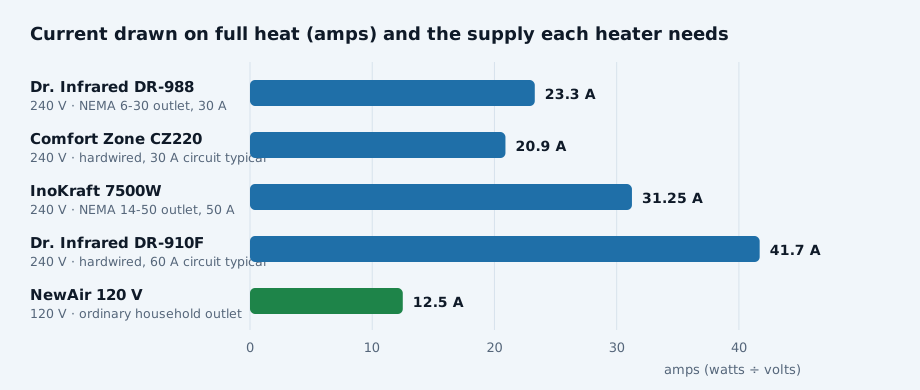
The ordinary garage outlet is a 120 V NEMA 5-15 socket on a 15 A circuit. A 1,500 W heater draws 12.5 A from it, almost the whole circuit, so nothing else should run on that circuit at the same time.
That 1,500 W, about 5,100 BTU per hour, is the ceiling for any plug-in heater on household power. Heaters sold as more powerful 120 V models are still limited by the same outlet.
Plug the heater directly into a wall socket. Extension cords and power strips can overheat under a load this size, and heater makers and US safety bodies advise against both.
How far 1,500 W goes
Going by roughly 10 W for each square foot of insulated garage floor, 1,500 W covers about 150 sq ft. The NewAir NGH160GA00 is rated for up to 160 sq ft, which agrees with that.
| Space | Heat needed, insulated | What 1,500 W covers |
|---|---|---|
| Shed or bench corner, 160 sq ft | about 1,600 W | nearly all of it |
| One-car garage, 264 sq ft | 2,500 to 3,000 W | roughly half |
| Two-car garage, 576 sq ft | 5,000 to 6,000 W | roughly a quarter |
| Three-car garage, 864 sq ft | about 8,600 W | under a fifth |
An uninsulated garage needs more again, so the shortfall grows. Our garage heater sizing guide explains the rule and what pushes your number up.
Current draw and supply, side by side
The chart sets the current each heater draws on full heat against the supply it needs. The NewAir is the only one that runs from an ordinary outlet; the other four need a 240 V circuit.
Where a 120 V heater earns its place
- At the bench: aimed at the spot where you stand, it takes the chill off your hands and legs
- A small shed or studio: around 150 sq ft and insulated, 1,500 W can hold a working temperature
- Short jobs: an hour of glue-up or a quick repair, where warming the whole garage is not needed
- Renters: where adding a circuit is not an option, a bench heater is the realistic choice
Owner reports on the NewAir follow the same line. It is liked in sheds and studios and at the bench, while heat output gets mixed reports, with some owners saying it is not enough for their space, as our NewAir 120 V review sets out.
If spot heat is the goal, a radiant heater that warms you rather than the air can suit a drafty garage better. Our guide to infrared or fan-forced heat weighs the two.
Making 1,500 W go further
- Aim it at you: tilt the head toward your legs and hands instead of trying to warm the whole room
- Close the big door: one open door can undo half an hour of heating
- Seal the gaps: a bottom seal on the garage door stops the cold draft along the floor
- Start early: switch it on a while before you begin, so the bench and tools lose some chill
- Close off a corner: a curtain or partition around the bench gives the heater a smaller space to fill
None of these turns a bench heater into a garage heater. They do make the difference between a workable hour at the bench and cold hands, which is all a 1,500 W heater promises.
What about two 120 V heaters?
Two 1,500 W heaters give 3,000 W, but only if each sits on its own dedicated circuit. Most garages have one or two circuits, already shared with lights, the door opener or a freezer.
Even with two clear circuits, 3,000 W is about half what an insulated two-car garage wants. Never run two heaters on one circuit or one power strip.
What a 240 V circuit gets you
A dedicated 240 V circuit opens the range from 5,000 to 10,000 W. The Dr. Infrared DR-988 plugs into a NEMA 6-30 outlet on a 30 A breaker, and the InoKraft 7500W into the 50 A NEMA 14-50 outlet used for many EV chargers.
A 240 V heater does not fit a 120 V socket, and no adapter should ever make it fit. The price of that extra heat is a licensed electrician adding the circuit, and our 240 V wiring guide covers the typical breaker and wire sizes.
Running cost depends on heat, not voltage
A kilowatt-hour costs the same at 120 V or 240 V. A 1,500 W heater running flat out uses 1.5 kWh an hour; using 15 cents per kWh as a sample rate, an hour on full costs roughly 23 cents.
A 5,600 W heater on full uses 5.6 kWh, about 84 cents an hour, but it reaches the setting sooner and then cycles. Over a day the garage’s heat loss decides the bill, as the running cost guide works through using the rate on your own bill.
Choosing between them
If you want to work in a two-car garage through a cold winter, plan for 240 V. If you want warm hands at the bench, or you heat a small shed, a 1,500 W heater on its own outlet is a fair choice.
Our head-to-head of the NewAir and the Dr. Infrared DR-988 sets the two options against each other. The full lineup is in our guide to the best garage heater for your outlet, with the 120 V option at pick five and all five in the comparison table.
For bench heat with no 240 V outlet
The NewAir NGH160GA00 plugs into an ordinary outlet, is rated for 160 sq ft and has a tilting head to aim the warmth at you. It will not heat a cold two-car garage; for that, the Dr. Infrared DR-988 on a 240 V outlet is the step up.