Eight safety rules for an electric garage heater
An electric heater makes no flame and no exhaust, which makes it one of the safer ways to heat a garage. A garage still holds fuel cans and clutter, so these eight rules cover the ways a heater can still cause trouble and how to avoid them.
Why garages need their own rules
An electric heater turns electricity into heat without a flame and burns no fuel, so it makes no carbon monoxide. The risks come from the supply and from what sits around the heater, and a garage has more of both than a living room.
The rules below come from general heating safety practice and what the heaters’ listings state. None of them is hard, and most cost nothing.
1. Choose a listed heater with overheat protection
Look for a recognized safety listing such as UL, ETL or CSA, and for overheat protection that shuts the heater off if it runs too hot. A portable heater should also switch off if it tips over.
The Dr. Infrared DR-988 is UL and C-UL listed with an automatic overheat cut-off, as our DR-988 review covers. The NewAir is ETL certified, and the DR-910F carries UL and cUL listings.
2. Give it the right circuit, installed by a pro
A 240 V heater needs a dedicated circuit with the breaker and wire sized for it. That work belongs to a licensed electrician, plus whatever permit and inspection your town asks for.
Our 240 V circuit guide gives the typical sizes, such as a 30 A breaker and 10 AWG copper for a 5,600 W unit. A 1,500 W heater should have its 120 V circuit to itself.
3. No extension cords, adapters or power strips
A heater draws a heavy current for hours, and a thin cord or a power strip can overheat under it. Makers of heaters and safety agencies alike advise against both.
Adapters that force a heater onto the wrong outlet are just as risky, because they bypass the protection the circuit was designed with. If the outlet is wrong, have the right one added.
Check the plug and outlet now and then. A plug that feels hot, or an outlet with brown marks around the slots, points to a loose or worn connection that an electrician should replace.
4. Keep it away from fuel, solvents and paint
Gasoline and solvent vapors, paint fumes included, are heavier than air and collect near the floor. A heater’s hot element or switch can ignite them, which is the most serious risk a garage heater carries.
- Never run any heater while you are fueling, spraying or using flammable liquids
- Store fuel cans and solvents well away from the heater, ideally in a closed metal cabinet
- Keep floor heaters out of the area where you fill the mower or work on a fuel system
- Read the manual, since many say not to use the heater where such liquids are stored or used
Air out the garage before you switch the heater back on after painting or cleaning parts. Vapors linger near the floor longer than the smell suggests, especially in a closed garage on a still day.
5. Mount it high and keep the clearances
A heater mounted on the ceiling or high on a wall is out of reach of low-lying vapors and of whatever crosses the floor, from cars to children. The figure compares a mounted heater with a portable one on the floor.
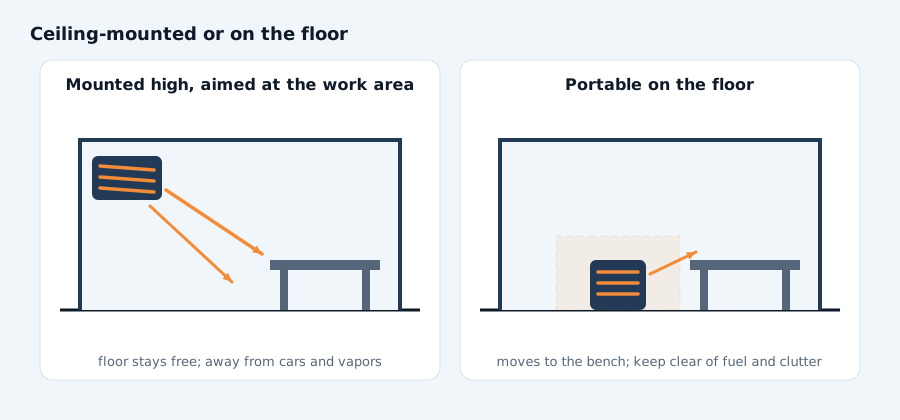
Whichever you use, keep the space the manual asks for clear of anything that can burn; many want about 3 ft in front of the grille. The mounting guide weighs a high spot against the floor.
6. Never cover it or dry things on it
Draping rags, gloves or a wet jacket over a heater blocks its airflow and puts fabric against the hottest part. The overheat cut-off may catch it, but it should never have to.
Keep cardboard and shop rags off the grille, and vacuum sawdust and dust from the intake now and then. Keep children and pets away from portable units.
7. Switch off when you leave
Unplug a portable heater when you leave the garage, even for a short trip into the house. A mounted, hardwired heater on a thermostat is designed to run unattended, but only once an electrician has installed it properly.
If you keep the garage warm overnight, a low setting of about 40 to 50 °F protects paint and glue without long run times. Our guide to setting a garage heater thermostat explains the choices.
8. Fit an alarm and heed the warning signs
A smoke or heat alarm in the garage is sensible. Electric heaters make no carbon monoxide, so a CO alarm protects against a car left running in an attached garage, not against the heater.
Treat a tripping breaker, a burning smell or a scorched plug as a reason to stop using the heater until the cause is found. Our guide to fixing trips and cold air sorts out which causes need an electrician.
The eight rules at a glance
- A listed heater with overheat protection
- A dedicated circuit, installed by an electrician
- No extension cords, adapters or power strips
- Distance from fuel and solvent vapors
- Mounted high, with the manual’s clearances
- Nothing covering it or drying on it
- Off and unplugged when you leave a portable
- A smoke alarm, and action on warning signs
For more general guidance, the NFPA’s heating fire safety page covers space heaters in every room of a home.
The safety features of all five heaters are listed in our guide to the safest electric garage heater choices, with a short checklist under before you buy and the top pick at pick one.
A listed heater that mounts out of the way
The Dr. Infrared DR-988 is UL and C-UL listed, has an automatic overheat cut-off and can hang on a wall or ceiling, away from vapors near the floor. It needs a NEMA 6-30 outlet put in by an electrician first.